Every Customer Success leader knows the sinking feeling of the “surprise churn.” You walk into a Quarterly Business Review feeling confident. The client hasn’t filed an angry ticket in months, and their last NPS score was a solid 8. The account looks healthy on paper. Then, at the renewal conversation, the client mentions they’re moving to a competitor.
This happens because the customer was quietly disengaging for months while your team watched the wrong signals. It’s the reality of silent churn: the slow, quiet abandonment of a product by users who never bother to complain. For years, CS teams have operated as firefighters, waiting for a low NPS score or an escalated ticket, then rushing in with discounts and apology tours. But reacting to fires is a flawed strategy for protecting Annual Recurring Revenue. The future belongs to forecasters, and AI is what makes that shift possible.
The Anatomy of Silent Churn
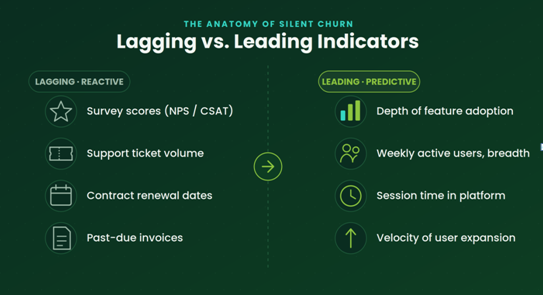
Most health scores lean on lagging indicators: survey results, ticket volume, renewal dates, and past-due invoices. If you’re waiting for a detractor score to know a customer is unhappy, the battle is already lost. Silent churners don’t fill out surveys; they simply stop logging in.
Leading indicators, by contrast, predict future behavior: depth of feature adoption, breadth of weekly users, session time, and the velocity of team expansion. CS teams already know these indicators exist. The real problem is volume. No CSM can manually cross-reference login frequency, feature adoption, and CRM activity across a hundred accounts every day, especially when that data sits split across Salesforce, a product analytics tool, and a CS platform. This is where AI stops being a buzzword and becomes an operational necessity.
How AI Turns Data into a Predictive Engine
AI thrives on exactly what overwhelms human CSMs: large, unstructured datasets. Embedding AI into a CS tech stack turns a static reporting habit into a dynamic, predictive one.
Multi-dimensional health scoring replaces static rules (“if logins drop below five a week, flag the account”) with behavioral models that learn from years of historical data. A model might find that a login dip barely matters for one user persona, while a drop in a single reporting feature predicts churn 90% of the time within 60 days.
|
S Cubes in practice: mid-market logistics-software client The problem: a health score built entirely on login counts, missing that renewal risk actually tracked a niche reporting module nobody watched. The fix: S Cubes rebuilt the client’s Gainsight health score around usage-weighted behavioral signals instead of raw logins. The result: flagged accounts moved from a lagging 40% false-positive rate to a leading indicator CSMs trusted enough to act on early. |
Sentiment analysis goes further than the survey. AI tools can read email threads and call transcripts to catch a stakeholder’s tone shifting from collaborative to brief, weeks before a human would notice.
|
S Cubes in practice: B2B payments client The problem: renewal conversations kept surprising the team despite decent survey scores. The fix: S Cubes layered natural language processing across support and email threads with a revised escalation playbook. The result: tone shifts surfaced early enough that the CS team could re-engage before a renewal was ever in question. |
AI also forecasts expansion, not just risk. By mapping the usage patterns of top-tier clients against mid-tier accounts, it surfaces “white space,” features a client has access to but isn’t using, prompting a well-timed upsell conversation.
The Implementation Reality: Tech Stack Architecture
Predictive AI is only as intelligent as the data feeding it. Plugging a model into a messy, siloed stack produces false positives and “alert fatigue,” where CSMs stop trusting the system altogether. Shifting from firefighting to forecasting requires three things first: a single source of truth where the CRM, ticketing system, and product analytics all feed the CS platform cleanly; clean historical data for the model to learn from; and mapped playbooks so that once AI flags a risk, a re-engagement sequence, outreach draft, and task assignment follow automatically.
|
S Cubes in practice: Series C HR-tech client The problem: a Salesforce instance full of duplicate accounts and a CS platform that hadn’t synced with product telemetry in months, so churn “predictions” were really just guesses. The fix: S Cubes ran a data-cleansing and integration project connecting Salesforce, the product analytics layer, and Gainsight into one pipeline, then built automated playbooks so flagged accounts triggered a CSM task within the hour. The result: churn tied to unnoticed risk signals dropped by roughly a third within two quarters. |
Empowering the Strategic Advisor
There’s a persistent fear that AI automation is coming for the CSM’s job. That misunderstands both the technology and the role. AI is poor at empathy: it can’t build rapport with a frustrated executive, navigate internal politics to secure budget, or brainstorm a bespoke strategy for a client’s unique problem. What AI is exceptionally good at is reading the data.
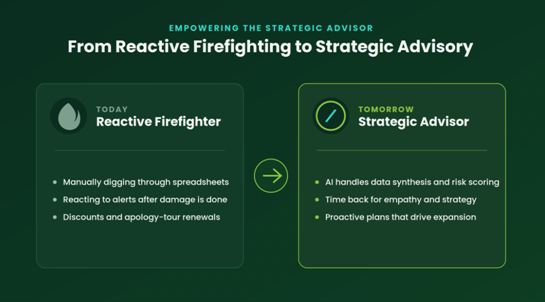
By outsourcing the backend work, data synthesis, manual health-score updates, and risk identification, AI frees CSMs from the spreadsheets and puts them back in front of the customer. Across the S Cubes engagements above, the common thread wasn’t replacing CSMs; it was giving them a health score, a sentiment signal, or a clean pipeline they could actually trust, so their time went to the client relationship instead of the data reconciliation behind it.
When the silent churn killer is neutralized through predictive forecasting, a CS team stops being a reactive support desk and becomes a proactive, strategic advisor driving measurable revenue growth. In modern B2B SaaS, that’s the only metric that truly matters.