Every Customer Success leader bought into the promise of Generative AI over the past eighteen months. The enterprise narrative was compelling: plug an intelligent assistant into your operational tech stack, automate manual administrative burdens, give your Customer Success Managers (CSMs) their days back, and watch Net Revenue Retention (NRR) climb. Software vendors promised that generative language models would summarize account histories in milliseconds, draft hyper-personalized customer communications, and predict churn before it surfaced.
Yet, walk onto any customer success floor today, and the reality looks starkly different.
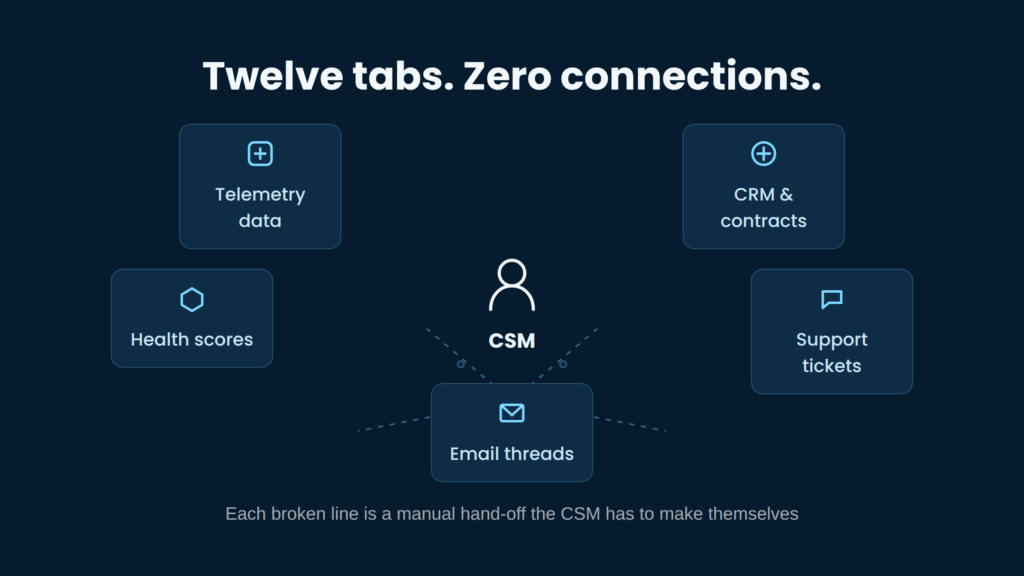
CSMs are still working 50-hour weeks. They are still drowning in context switching, jumping frantically across twelve different browser tabs spanning Gainsight, Salesforce, HubSpot, Zendesk, and Gong just to piece together what occurred in an enterprise account over the last sixty days. Customer Success leaders are left looking at ballooning software budgets and asking an uncomfortable question: If we invested so heavily in GenAI, why are our teams spending just as much time on repetitive manual work?
The short answer is that the SaaS industry fell for an illusion. Buying a generic GenAI tool or flipping on the native AI button inside an existing platform does not equal workflow optimization. In reality, isolated GenAI tools often introduce a brand-new layer of operational debt.
The Root of the Problem: Isolated Text Generation vs. End-to-End Orchestration
The fundamental flaw in modern enterprise AI adoption is confusing language generation with process execution.
Most off-the-shelf generative AI products operate as isolated digital islands. They are text-in, text-out engines. While an LLM is exceptionally gifted at rephrasing a paragraph, polishing an email response, or condensing a 45-minute call transcript into bullet points, it possesses zero intrinsic knowledge of your business logic, your underlying data models, or your cross-functional operational workflows.
When Customer Success teams deploy surface-level GenAI, they encounter three core friction points:
1. The Context Gap: Summaries Without Business Synthesis
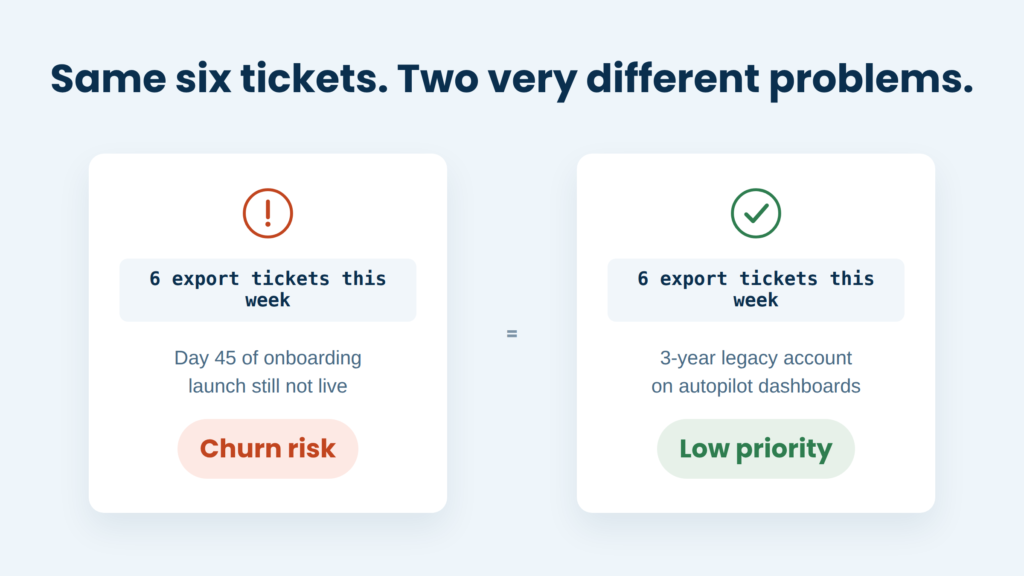
A generic language model can read a series of customer support tickets and correctly report: “The client opened six tickets this week regarding report exporting.” What it cannot do—unless explicitly engineered to do so—is understand what that event actually represents within the customer lifecycle.
If that client is in Day 45 of onboarding, those six export errors are an existential threat to customer launch and signal an immediate churn risk. If that customer is a three-year enterprise legacy account on an automated dashboard plan, it is a low-priority bug. Off-the-shelf AI treats both scenarios with identical priority because it lacks operational context. It summarizes data points without synthesizing business impact, leaving the CSM to manually audit the account anyway.
2. The Multi-System Data Silo (The “Franken-Stack” Trap)
Enterprise customer data does not live in a single clean repository. Product telemetry sits in Snowflake or Mixpanel. Commercial terms, renewal dates, and pipeline opportunities live in Salesforce. Health scores and engagement cadence reside in Gainsight. Support tickets sit in Zendesk, while executive email threads remain trapped in Gmail or Outlook.
When you install a generic AI assistant inside just one of these systems (for example, a CRM copilot), its visibility is hard-capped by that tool’s perimeter. It cannot cross-reference a sudden dip in telemetry with a series of frustrated Zendesk tickets from an unrecorded executive sponsor. Because the AI cannot bridge the “Franken-Stack,” the CSM remains the human API middleware, manually compiling data from three other dashboards to confirm whether the AI’s summary is even accurate.
3. The Execution Dead End
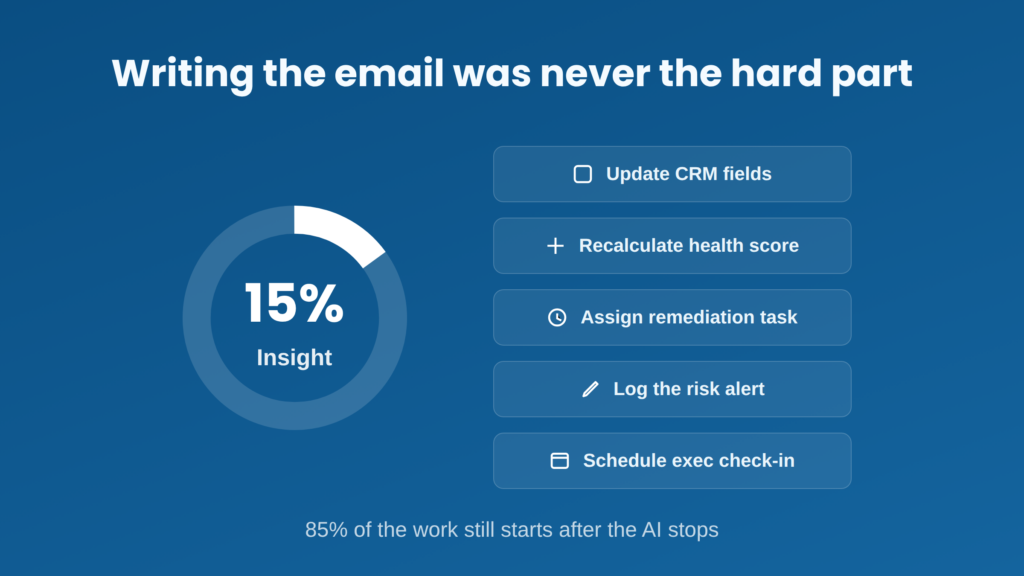
Drafting an email or producing an insight is only 15% of a CSM’s workload; the remaining 85% is action. After identifying a problem, a CSM must update custom fields in the CRM, adjust health score weights, assign a remediation task to an implementation engineer, log an internal risk alert, and schedule an executive check-in.
Generic GenAI does not execute across applications. It produces static text in a side-panel widget, leaving the CSM to copy, paste, cross-check, and manually implement the required operational steps. The outcome is not time saved; it is simply a different form of administrative toil.
Moving from Static Chatbots to MCP-Driven Agentic Workflows
Breaking free from this cycle requires re-architecting how AI interacts with your Customer Success architecture. High-performing organizations are shifting away from passive copilots toward Model Context Protocol (MCP) architectures and goal-driven autonomous agents.
Instead of asking a CSM to prompt a chatbot, an agentic framework sits natively across your entire revenue stack. Connected via standard protocol layers directly to your databases and core platforms, an MCP agent doesn’t simply answer questions—it coordinates workflows:
- It proactively monitors disparate data streams (telemetry, commercial data, and communications).
- It synthesizes correlations (e.g., matching a drop in daily active licenses with the departure of a primary champion logged in LinkedIn or email threads).
- It takes authorized multi-platform actions: updating a Gainsight scorecard, drafting a customized renewal risk mitigation plan, and staging a tailored agenda for the executive sponsor in the CSM’s outbound queue.
To see how this transformation functions in real-world scenarios, consider how these operational bottlenecks are solved through structural integration rather than generic text generation.
CASE STUDY 1 • Global Enterprise B2B SaaS
Eliminating the QBR Preparation Black Hole
The Problem: A 350-account B2B SaaS company gave its 35-person CS team enterprise GenAI licenses to cut QBR prep time (4.5 hrs/account/quarter). Six months later, prep time barely moved the AI wrote great slides, but CSMs still spent hours manually pulling data from Snowflake, Salesforce, and Jira.
The Fix: S Cubes built an MCP-driven agentic pipeline connecting Gainsight, Salesforce, and telemetry data auto-triggering 21 days pre-QBR to pull adoption metrics, cross-reference tickets/sentiment, and generate a fully branded, ROI-calculated slide deck automatically.
The Result: QBR prep dropped from 4.5 hours to 35 minutes, reclaiming ~140 hours/CSM/year. CSMs shifted from data reporting to strategic, upsell-focused conversations.
CASE STUDY 2 • Scaled HealthTech
Unmasking the False “Green” Account Fallacy
The Problem: A health tech company’s AI sentiment tool scored accounts “Green” based on polite emails, even as usage dropped 40%, tickets piled up, and stakeholders went dark. Clients churned right after showing healthy scores.
The Fix: S Cubes rebuilt the health-scoring model in Gainsight, weighting real usage data at 65% over sentiment, added a “Silent Disengagement” alert for tone/usage divergence, and removed the AI’s ability to self-mark an account healthy forcing human review instead.
The Result: Churn risk surfaced 72 days before renewal (vs. an industry baseline of 30), driving a 22% YoY reduction in enterprise churn.
Architectural Checklist: How to Move from Vanity AI to Real CS ROI
If your Customer Success organization is evaluating its existing AI investments or preparing to implement automation in your tech stack, avoid the common trap of adopting standalone consumer-grade tools. True efficiency gains require a disciplined architectural approach:
| Focus Area | The Vanity AI Trap (What Doesn’t Save Time) | The Architectural Approach (What Drives Real ROI) |
| Data Integration | Isolated copilots residing within a single tool UI (e.g., CRM-only text generators). | Unified data layers connecting telemetry, billing, support tickets, and CRM records. |
| Operational Output | Unstructured paragraphs of text that a CSM must manually read, verify, and re-enter. | Structured data actions: automated field updates, scorecard recalculations, and staged actions. |
| Churn Detection | Basic keyword and conversational sentiment scoring parsed from email threads. | Telemetry-first behavioral modeling that flags divergence between words and actual usage. |
| CSM Interaction | Forcing team members to write complex text prompts to extract basic data points. | Autonomous event-driven agents that run in the background and surface alerts when action is required. |
The Path Forward: Building a Foundation for Scalable Retention
Generative AI will continue to reshape Customer Success, but competitive advantage will not belong to the teams with the most browser extensions or chatbot licenses. It will belong to the organizations that treat their technology stack as a coherent, connected ecosystem.
True customer success efficiency means eliminating administrative fragmentation at the data layer. When your platforms communicate fluently, when health scores reflect operational reality rather than polite small talk, and when automated agents orchestrate repetitive cross-platform workflows, your CSMs can finally stop acting like data-entry clerks.
They can return to the work that actually protects and expands Net Revenue Retention: building strategic executive partnerships, unlocking customer value, and driving sustainable enterprise growth.