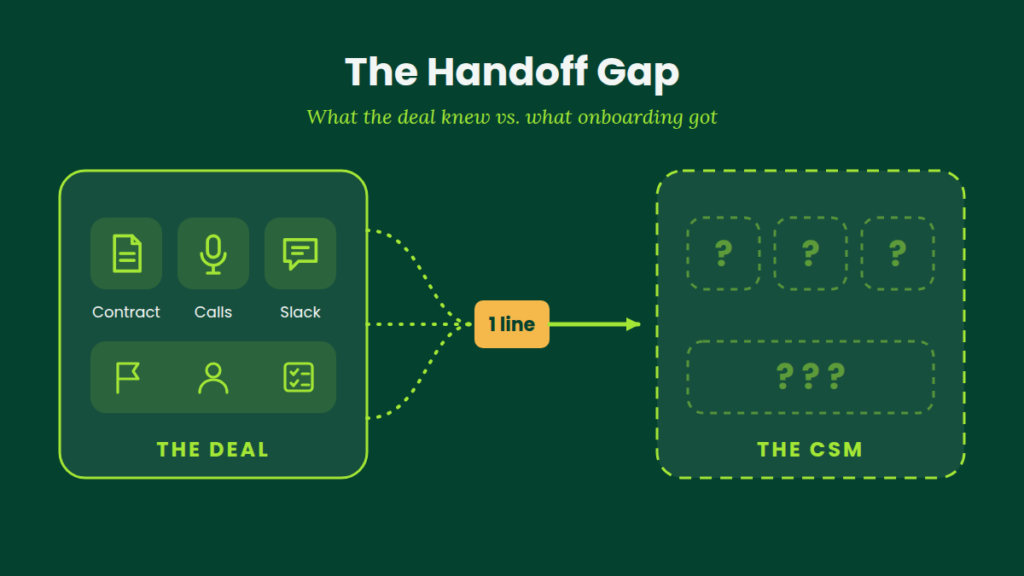
The deal closes on a Friday. The contract is signed, the sales channel lights up with celebration emojis, and the account is handed to Customer Success. On Monday morning, the CSM opens the record and finds a single line in the handoff note: “Enterprise, three modules, wants to go live fast.”
Everything else the customer was promised sits somewhere else. The custom SSO requirement is in a call recording. The hard go-live deadline tied to the customer’s fiscal quarter is in a contract PDF. The executive sponsor who only cares about reporting was mentioned once, in a Slack thread nobody saved. The CSM now has to reconstruct all of it by hand, while thirty other accounts compete for attention.
This is how most B2B SaaS onboarding begins, and it is where a surprising amount of future churn is quietly seeded. Customers who do not reach their first meaningful outcome quickly rarely become advocates. They become renewal risks who just have not announced it yet.
Agentic AI offers a practical way to fix this. Not by replacing the CSM, but by taking over the coordination work that keeps onboarding slow, generic, and reactive.
Why onboarding is where retention is really decided
Time-to-value is the gap between signing a contract and the customer experiencing the outcome they bought the product for. Every extra week in that gap carries a cost. Champions lose momentum, budgets get questioned, and internal priorities shift. By the time the customer finally goes live, the excitement from the buying process has often faded.
Most teams know this, and most have invested in onboarding. They have kickoff decks, implementation checklists, and milestone trackers in Gainsight, Salesforce, or HubSpot. The problem is not a lack of process. The problem is that the process is static while the customers are not.
The trouble with the one-size-fits-all checklist
A standard onboarding checklist assumes every customer is roughly the same. In reality, a ten-person pilot and a global rollout with security reviews, data migrations, and multiple stakeholder groups have almost nothing in common. Yet both often receive the same template.
This creates predictable failure points:
- Lost deal context: Commitments made during the sales cycle never reach the people responsible for delivering them.
- Generic plans: Milestones are not adjusted for contract terms, integrations, or the customer’s real deadlines.
- Silent stalls: A customer misses a data-sharing task, nobody notices for two weeks, and the project slips.
- Manual chasing: CSMs spend hours writing reminder emails and updating status fields instead of guiding the customer.
A checklist can tell you a task is overdue. It cannot decide why, who needs to hear about it, or what should happen next.
What an onboarding agent actually does
An agentic system is different from a workflow rule or a chatbot. It works toward a goal, in this case getting the customer to first value, by reading information, making decisions within defined limits, and taking action across your systems. Connected through integrations and the Model Context Protocol (MCP), an onboarding agent can work across your CRM, customer success platform, and communication tools.
In practice, that means it can:
- Read the deal, not just the handoff note. It reviews contract terms, order forms, and sales notes to extract commitments, deadlines, required integrations, and key stakeholders.
- Build a tailored onboarding plan. Instead of applying a template, it assembles milestones that match the customer’s scope, complexity, and timeline, and creates the matching Cockpit tasks and playbooks in Gainsight.
- Watch for activation signals. It monitors whether the right people are logging in, whether data has been connected, and whether early usage matches what a healthy implementation looks like.
- Nudge the right person at the right moment. When a milestone is at risk, it drafts a targeted follow-up to the customer stakeholder who owns the blocker, not a blanket reminder to everyone.
- Escalate before it becomes a crisis. If an implementation is drifting off course, it alerts the CSM and onboarding lead with the context needed to act, including what has stalled, for how long, and what has already been tried.
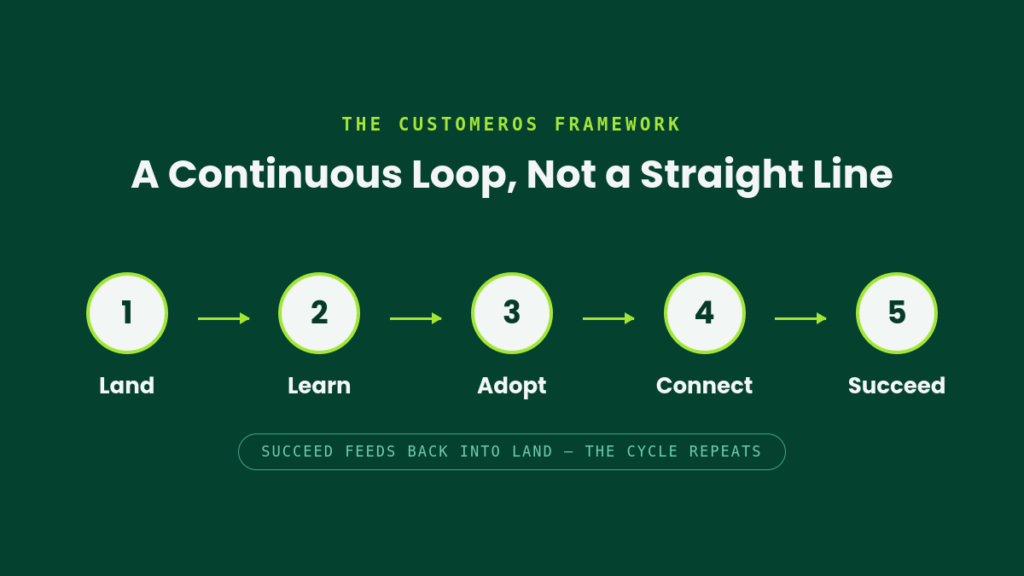
The result is an onboarding motion that adapts to each customer instead of forcing every customer through the same path.
Where humans stay in charge
Onboarding is a relationship-building moment, and that part should never be automated away. The most effective designs keep people in control of the moments that matter:
- Approving any customer-facing message that touches pricing, scope, or sensitive issues
- Leading the kickoff call and executive conversations
- Making judgment calls when a customer’s priorities change mid-implementation
- Deciding when to bend the plan for a strategic account
The agent handles the coordination, monitoring, and first drafts. The CSM handles the trust. When the balance is right, CSMs spend less time on status updates and more time on the conversations that actually build confidence.
Case Study 1: Cutting time-to-first-value for an HR tech platform
The challenge
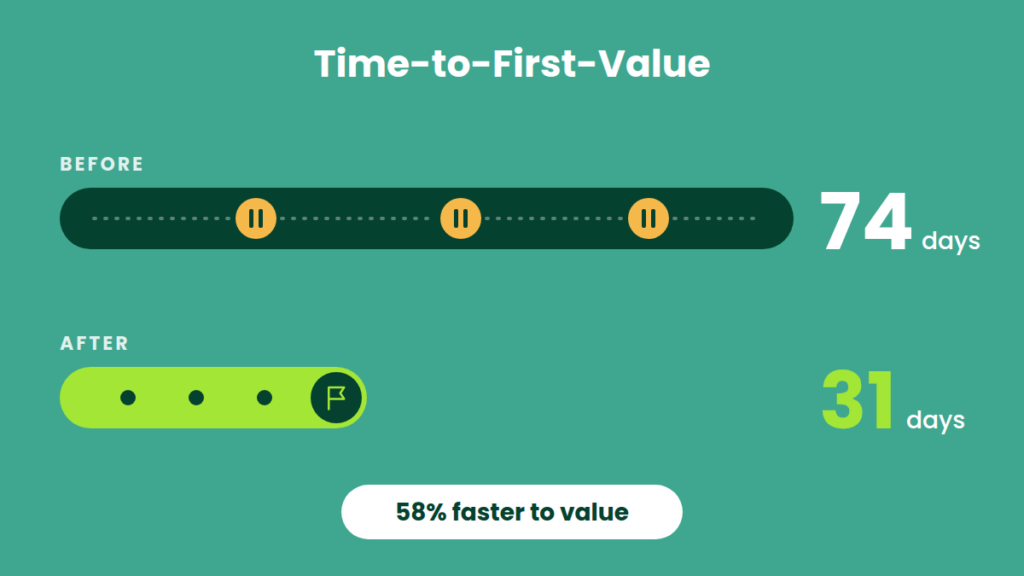
“PeopleLoop” is a mid-market HR technology provider with roughly $30M in ARR. Its product required customers to connect payroll data, configure approval workflows, and train managers before seeing any value. Onboarding ran on a shared checklist, and the average time to first value had stretched to 74 days. Only 38% of new customers finished onboarding on schedule. CSMs spent roughly nine hours preparing each new account, largely by digging through sales notes and contracts.
How S Cubes helped
Deal-to-onboarding data flow: S Cubes connected Salesforce opportunity data and contract details to Gainsight, so commitments, stakeholders, and deadlines arrived with every new account automatically.
Onboarding agent with MCP integration: An AI agent was configured to read each deal’s context and generate a tailored milestone plan, mapped to Gainsight Cockpit tasks.
Stall detection and targeted outreach: The agent tracked integration and training milestones and drafted follow-ups to the specific customer owner of each blocked task, with the CSM approving anything customer-facing.
Risk alerts for the team: Projects slipping beyond defined thresholds triggered an alert with a summary of what had changed and a suggested next step.
The result
Within two quarters, the average time to first value fell from 74 days to 31. On-time onboarding completion rose from 38% to 81%, and CSM preparation time per new account dropped from about nine hours to under two. The team reinvested that time in executive kickoffs and adoption workshops, and early customer feedback on the onboarding experience improved noticeably.
.
Case Study 2: Preventing stalled implementations at a healthcare SaaS provider
The challenge
“CareSync Health” sells scheduling and patient-engagement software to hospital networks. Its implementations were complex, involving EHR integrations, security reviews, and multiple departments. Roughly 27% of projects stalled for more than three weeks, usually waiting on a customer-side task that nobody noticed was blocked. Average time from signature to go-live was 118 days, and only 52% of customers reached full activation within 90 days of launch.
How S Cubes helped
Unified implementation view: S Cubes restructured Gainsight and HubSpot so that implementation tasks, support tickets, and stakeholder activity appeared in one account timeline.
Agentic stall monitoring: An AI agent watched for quiet periods, missed handoffs, and unanswered requests across email, tickets, and project milestones, and identified which stakeholder owned each delay.
Context-rich escalations: Instead of a generic overdue alert, the agent sent the onboarding lead a short briefing: what was blocked, since when, who owned it, and a drafted message ready for review.
Playbook learning: Resolution patterns from past implementations were used to suggest next steps, such as looping in a customer’s IT security contact earlier when integration reviews tend to lag.
The result
Within six months, stalled projects dropped from 27% to 9%. Average time to go-live shortened from 118 days to 79, and 90-day activation climbed from 52% to 77%. Implementation managers reported that the biggest change was predictability: they stopped discovering problems at the weekly review and started resolving them days earlier.
Where to start
You do not need to automate your entire onboarding journey at once. A practical starting point looks like this:
Ready to shorten your time-to-value and make onboarding a competitive advantage? Connect with the team at S Cubes IT Consulting to see how Gainsight, Salesforce, HubSpot, and agentic AI can work together for your customers.