
In the current B2B SaaS landscape, customer success (CS) and revenue leaders are facing an unprecedented paradox. Never before have we had access to so much data, yet so many organizations are caught completely off guard when enterprise accounts quietly churn.
Dashboards overflow with metrics, alerts ping Slack channels around the clock, and customer health scores flash green right up until the moment a cancellation notice lands in your inbox. Why? Because collecting data is no longer the bottleneck context fragmentation is.
When your billing data lives in Stripe, product usage sits in Snowflake, customer communication is buried in HubSpot, and your success execution happens in Gainsight, you don’t have a single source of truth. You have an archipelago of isolated data islands. And ships easily sink between islands.
Protecting and expanding Net Revenue Retention (NRR) requires more than just buying another enterprise software license or configuring basic automated emails. It requires a fundamental shift in how your technology stack is architected, governed, and connected to intelligent workflows.
The Hidden Cost of Fragmented Customer Data
Most growing technology companies build their tech stacks incrementally. You start with a CRM for sales, add a ticketing system for support, bolt on a customer success platform (CSP) as you scale up-market, and introduce specialized point solutions along the way.
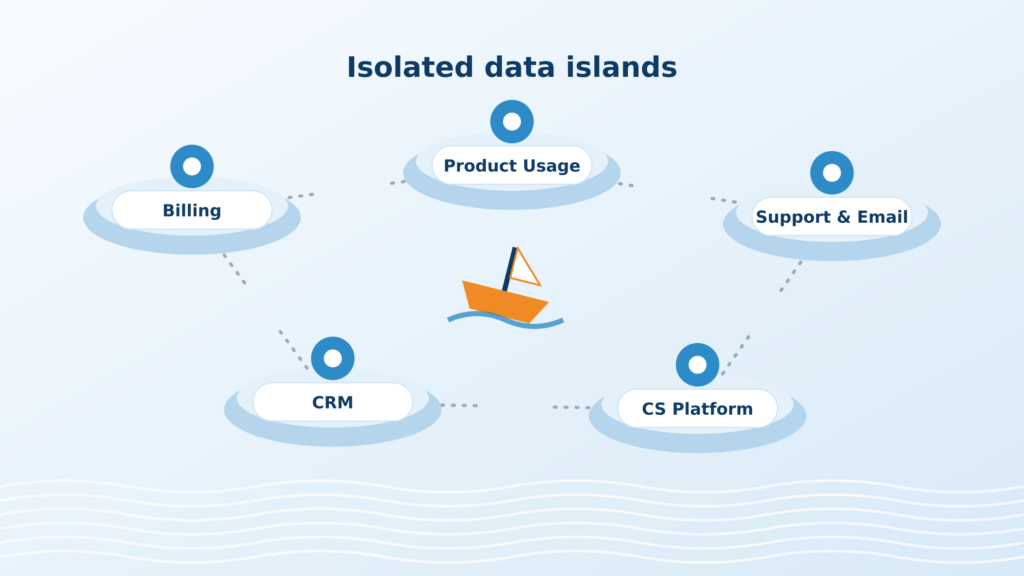
While this organic growth is natural, it creates severe structural liabilities:
- Blind Spots in the Customer Journey: Success managers spend hours manually cross-referencing CSV exports and hopping between tabs just to prep for an Executive Business Review (EBR).
- Reactive Firefighting: Health scores based solely on static metrics (like login frequency) miss critical behavioral shifts, such as a drop in feature depth adoption by key power users.
- Wasted Team Capacity: Highly skilled CSMs spend up to 40% of their day on administrative data entry rather than driving adoption, relationship-building, and value realization.
To turn customer success into a predictable growth engine, your systems must do more than store information they must synthesize it in real time.
Moving from Lagging Indicators to Predictive Signals
Traditional customer health scoring is fundamentally flawed because it relies on lagging indicators. By the time support ticket volume spikes or license utilization drops below a threshold, the customer has already mentally checked out.
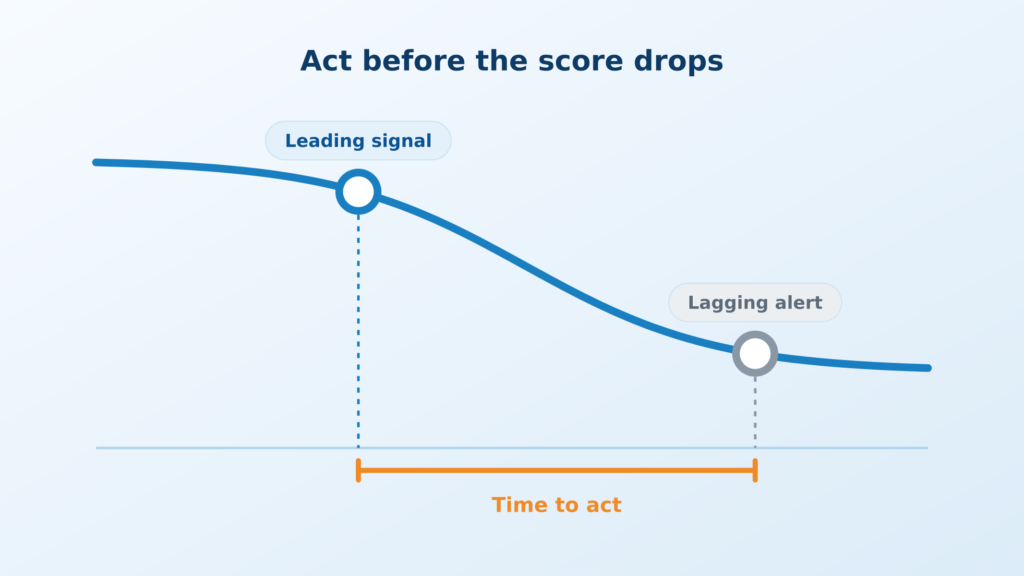
True customer intelligence requires moving toward leading indicators:
- Breadth vs. Depth of Adoption: Are multiple departments utilizing core features, or is adoption siloed with a single champion?
- Contextual Engagement Velocity: How quickly does a customer adopt new product releases or respond to value-driven outreach?
- Sentiment & Stakeholder Mapping: Are you multi-threaded across the client’s executive and operational layers?
Achieving this level of predictive visibility requires deep platform orchestration seamlessly bridging Salesforce or HubSpot with Gainsight NXT or Planhat, backed by modern AI workflows that parse unstructured communication data instantly.
Case Study 1: Transforming Mid-Market SaaS Health Scoring & NRR
The Challenge
A mid-market enterprise collaboration software company with $25M in ARR was struggling with a stagnant NRR of 94%. Their customer success team relied on a legacy CRM setup where health scores were calculated manually once a month. Because product usage data from their data warehouse was never synced with their Customer Success Platform (Gainsight), accounts with declining feature adoption appeared healthy simply because they paid their invoices on time.
How S Cubes IT Consulting Helped
S Cubes partnered with their leadership team to completely re-architect their CS tech stack over a 6-week engagement:
- Unified Data Architecture: We established automated, real-time data pipelines connecting Snowflake product telemetry directly into Gainsight MDA (Multidimensional Database) objects.
- Dynamic Health Scoring Model: We replaced their static scorecard with a multi-layered model factoring in feature breadth, license utilization trends, and support ticket sentiment.
- Automated Playbooks & Cockpit Triggers: We built custom Journey Orchestrator programs that automatically assigned risk playbooks to CSMs the moment a key stakeholder’s login frequency dropped by 30% over a 14-day window.
The Result
Within two quarters of deployment, the company reduced its involuntary churn window from reactive discovery to proactive intervention. Their net revenue retention jumped from 94% to 108%, and CSM administrative overhead was cut in half, allowing them to handle a 35% larger book of business per manager without sacrificing service quality.
Case Study 2: Automating Proactive Risk Mitigation with Agentic Workflows
The Challenge
A fast-growing FinTech infrastructure platform was onboarding dozens of new enterprise clients every month. While their HubSpot CRM and Gainsight deployment captured core milestones, their support channels (email, Slack connect channels, and helpdesk tickets) were flooded with unstructured feedback. Critical risk signals such as complaints about API latency or friction during integration were buried in unstructured text threads, escaping the notice of account managers until renewal discussions stalled.
How S Cubes IT Consulting Helped
We implemented an advanced AI and integration framework leveraging Model Context Protocol (MCP) and custom workflow orchestration:
- Context-Aware AI Integration: We connected their communication layers and CRM data to intelligent, secure AI agents capable of analyzing sentiment and intent across unstructured interaction logs.
- Automated Risk Summaries: Instead of forcing CSMs to read hundreds of support chat logs, the system synthesized weekly natural language briefings highlighting shifting customer sentiment and surfacing immediate risk alerts directly inside the Gainsight Cockpit.
- Prescriptive Next Steps: The AI agent automatically drafted initial executive risk assessment summaries and suggested remediation steps based on historical success playbooks.
The Result
The FinTech startup slashed its average risk identification and response time from 5 days to under 3 hours. Customer satisfaction scores (CSAT) rose to 4.9/5, and the organization successfully secured a 22% increase in expansion revenue from existing accounts through timely, data-backed identification of cross-sell opportunities.
.
Architecting the Future of Customer Success
Technology should never replace the human empathy and strategic guidance that drive true B2B partnerships; instead, it should amplify them. When your CRM, CSP, and AI workflows operate as a single, cohesive ecosystem, your team stops guessing and starts scaling with absolute confidence.
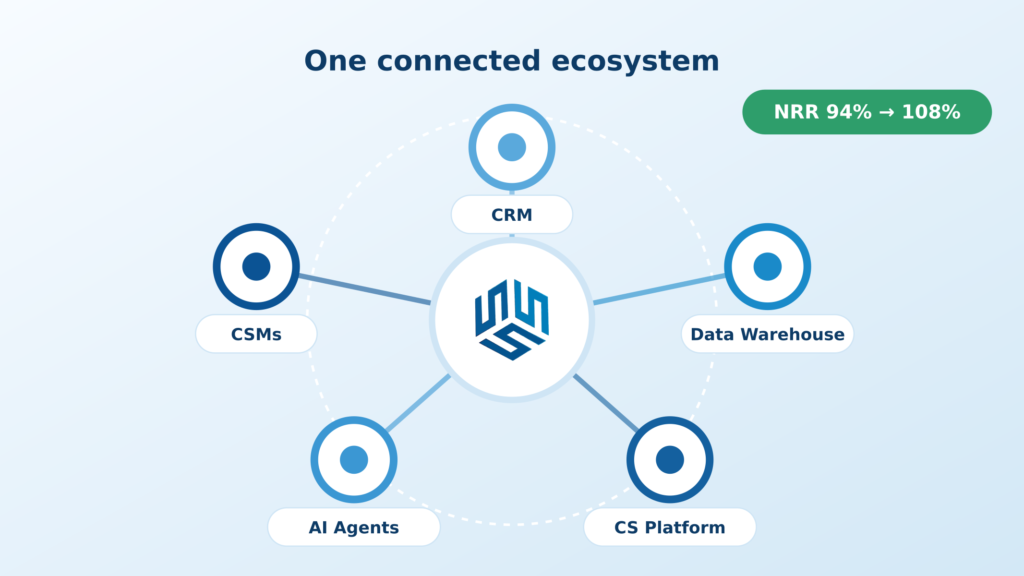
Whether you are looking to migrate from a legacy CRM, optimize your Gainsight and HubSpot architecture, or deploy cutting-edge agentic AI workflows, you don’t need another generic software tutorial you need a strategic partner who has sat in your seat.
Ready to turn your customer data into a sustainable engine for revenue retention?
Connect with the team at S Cubes IT Consulting today, and let’s build an infrastructure designed for scalable growth.