
For the past decade, the playbook for cybersecurity and technology leaders (CISOs, CIOs, and Security Directors) has centered on a familiar mantra: secure the perimeter, manage human users, and enforce the principle of least privilege. We built sprawling Identity and Access Management (IAM) systems, rolled out multi-factor authentication (MFA) across the board, and treated human employees as both the primary vulnerability and the final line of defense.
Today, that playbook is rapidly losing its efficacy.
As enterprises aggressively scale their technology stacks, integrating autonomous software workflows, continuous integration pipelines, and intelligent AI agents the modern corporate ecosystem is no longer driven solely by human hands. Organizations are giving birth to a massive, often invisible workforce of non-human identities (NHIs): API keys, service accounts, automated scripts, OAuth tokens, and autonomous AI agents capable of making runtime decisions and executing financial or data transactions without direct human oversight.
For cybersecurity leaders, this paradigm shift represents a monumental blind spot. How do you govern an entity that doesn’t sleep, doesn’t take security training, and possesses autonomous privileges that vastly outstrip those of an average employee?
The Rise of the Machine Workforce and Shadow Automation
Walk into any modern enterprise architecture meeting, and you will hear executives championing agility, hyper-automation, and speed to market. Automated microservices pull data from external APIs, LLM-driven agents parse customer sentiment and execute CRM updates, and DevOps pipelines push code production changes dozens of times a day.
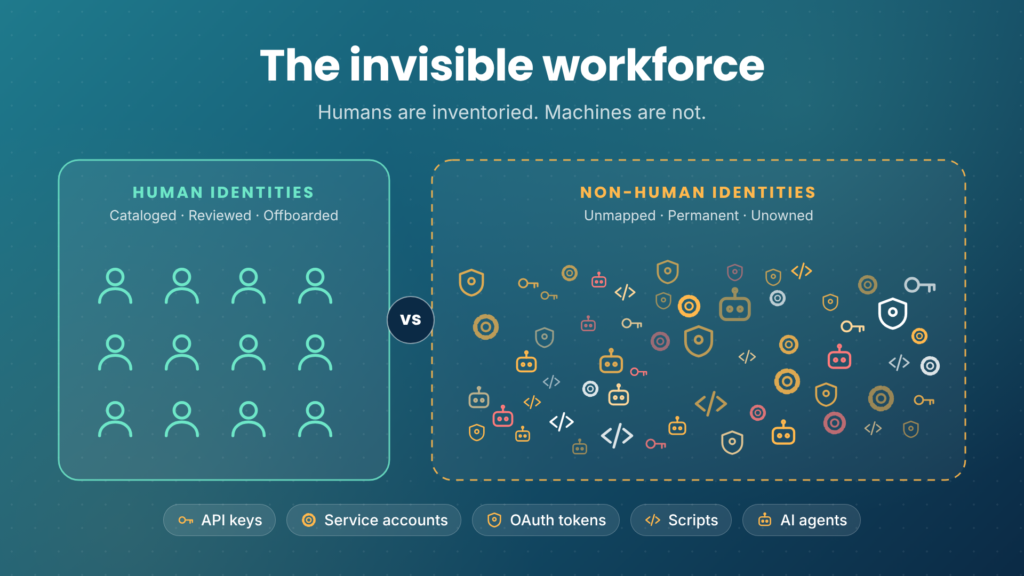
Underneath this velocity lies a staggering accumulation of technical debt and risk: unmanaged non-human identities.
- Proliferation without Inventory: Most organizations have a clear catalog of active human employees, contractors, and their respective permissions. Ask those same organizations to produce a definitive, real-time inventory of every active API token, service principal, or AI agent credential, and progress often grinds to a halt.
- The “Permanent Privilege” Trap: Unlike human users whose permissions are subject to regular reviews, role changes, and offboarding workflows, service accounts and API keys are frequently granted broad, permanent access credentials during deployment and then forgotten.
- Shadow AI and Autonomous Spread: Business units deploy their own automation tools and script integrations to solve immediate operational bottlenecks, bypassing IT security gates entirely. When these tools hook into enterprise databases, they create unauthorized, unmonitored pathways straight into core company data.
When threat actors scan modern corporate networks, they no longer waste time trying to crack heavily fortified human login portals or execute complex social engineering campaigns if they can simply hijack an orphaned API key with administrative privileges.
Shifting from Control to Continuous Exposure Management
Addressing the non-human identity crisis requires more than just tightening traditional IAM policies. Security leadership must pivot from static perimeter defense to Continuous Threat Exposure Management (CTEM) and rigorous machine-identity governance.
To get ahead of this curve, forward-thinking cybersecurity leaders are focusing on three core imperatives:
1. Treating Machine Identities with Human-Level Rigor
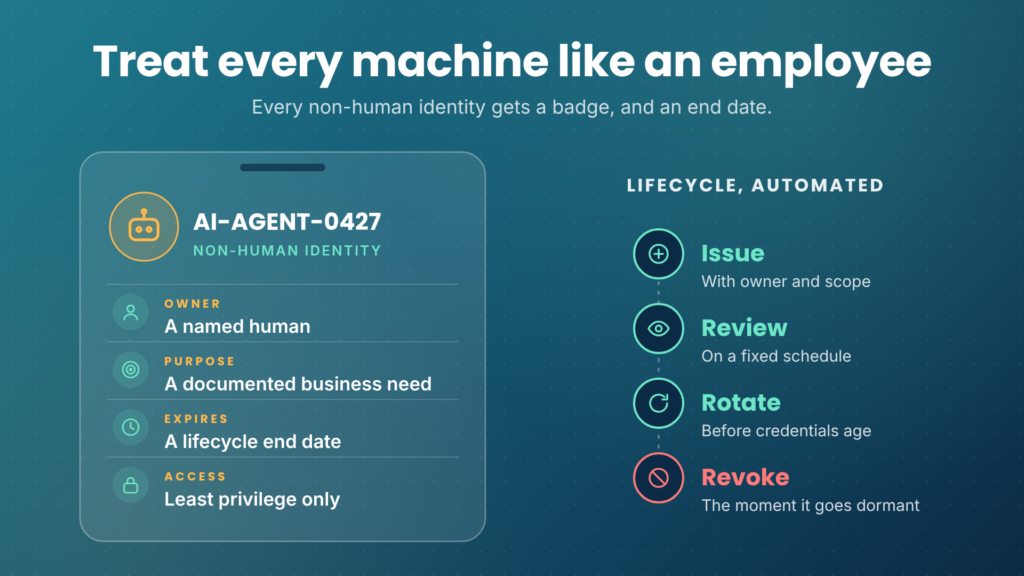
Every AI agent, service account, and API integration must be treated as a distinct digital employee. That means mapping clear accountability: every non-human identity must have a designated human owner, an explicit business purpose, a lifecycle expiration date, and access boundaries mapped strictly to the principle of least privilege.
2. Automated Discovery and Lifecycle Governance
Manual spreadsheets and periodic quarterly audits cannot keep pace with cloud-native development cycles. Enterprises must deploy automated discovery tools that constantly scan code repositories, cloud environments, and network traffic to catalog active NHIs, flag anomalous behavior, and automatically revoke dormant or over-permissioned tokens.
3. Securing the AI Agentic Loop
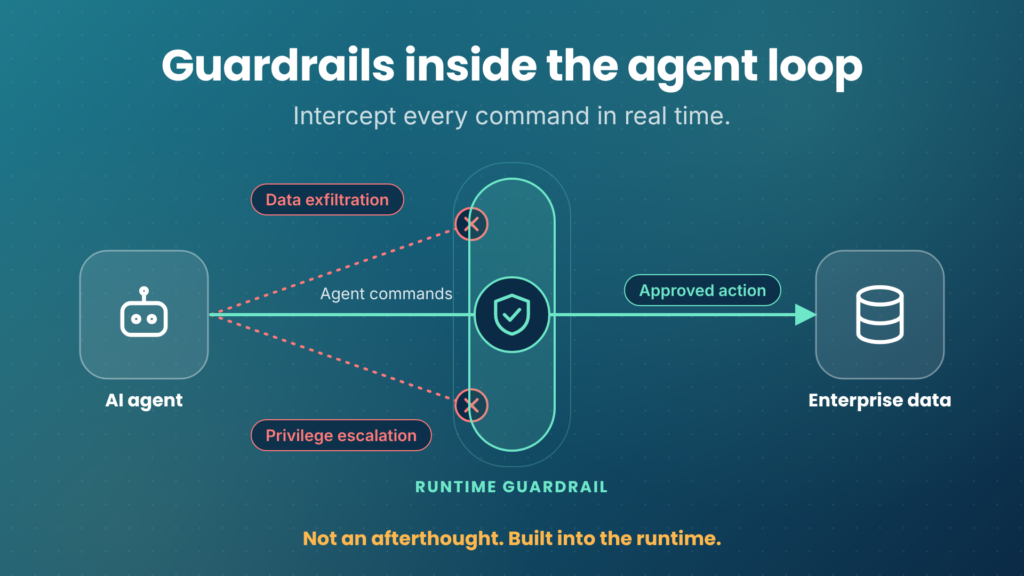
As organizations move from passive generative AI tools to active, autonomous agentic systems that can execute actions across enterprise boundaries, security must be baked into the runtime environment. Guardrails cannot be an afterthought; they must intercept agent commands in real time to prevent unauthorized data exfiltration or unintended privilege escalation.
CASE STUDY
Proven Impact: How S Cubes Delivers Secure Automation
Here is how S Cubes has helped modern enterprises bridge the gap between agility and robust non-human identity governance:
-
- FinTech SaaS Transformation: A rapidly growing FinTech SaaS provider aggressively scaled its automation stack with autonomous AI agents and microservice integrations, creating an unmonitored shadow automation blind spot. By partnering with S Cubes to implement automated NHI discovery and runtime guardrails, the client eliminated 85% of dormant, over-permissioned service tokens within 30 days while securely scaling their AI agent workflows.
- Healthcare Tech Visibility: A mid-sized healthcare software provider struggled with legacy technical debt consisting of hundreds of legacy service accounts and hardcoded API tokens connecting external systems to patient data pipelines. S Cubes deployed continuous exposure management frameworks that delivered 100% visibility over active machine identities, automating token rotation and ensuring strict data privacy compliance with zero downtime for mission-critical services.
.
.
The Path Forward: Balancing Velocity with Resilience
The mandate for cybersecurity leadership is uniquely challenging. Security can no longer afford to be seen as the “department of no” that slows down innovation. Business units demand speed, automation, and AI-driven efficiency to stay competitive.
However, true business resilience cannot exist without visibility. By taking control of non-human identities, auditing automated workflows, and establishing robust governance frameworks for the machine workforce, CS leaders can protect their organizations without stifling progress.
The perimeter is gone, and the definition of a “user” has fundamentally transformed. The question facing every technology leader today isn’t whether your human team is secure it’s who or what is operating inside your network right now while nobody is watching.
At S Cubes, we help enterprises navigate complex digital transformations, secure modern workflows, and build resilient architectures designed for the age of automation. How is your organization managing non-human identities and AI governance? Let’s discuss in the comments below.