
For most growing B2B enterprises, technology expansion does not happen overnight. It happens incrementally. Marketing adopts HubSpot to capture inbound demand and execute multi-touch attribution campaigns. Sales relies on Salesforce to track pipeline velocity, manage commercial terms, and forecast quarterly revenue. Meanwhile, Customer Success teams implement Gainsight to monitor product adoption, calculate health scores, and run retention playbooks.
On paper, this looks like a best-of-breed revenue stack. Yet, ask any Chief Revenue Officer, Head of Sales, or Customer Success leader what happens when a client transitions from a closed-won opportunity to active onboarding, and you will likely hear a familiar frustration: data loss, delayed handoffs, and operational blind spots.
When customer data remains trapped in functional silos, your organization pays a heavy toll. CSMs spend hours acting as manual data-conduits between platforms, sales teams lose visibility into post-sale health degradation, and leadership struggles to calculate true customer lifetime value (LTV).
To scale past the $20M to $100M ARR threshold, companies must move beyond surface-level integrations and architect a unified omnichannel data fabric across HubSpot, Salesforce, and Gainsight. Here is why structural alignment matters, where traditional architectures break down, and how leading organizations are turning their tech stack into a true competitive advantage.
The Anatomy of the Revenue Chasm
The modern buyer journey is non-linear. A prospect engages with multiple marketing assets, interacts with sales development representatives, negotiates enterprise terms, and finally onboard onto a SaaS platform. Each of these stages generates critical behavioral and financial data.
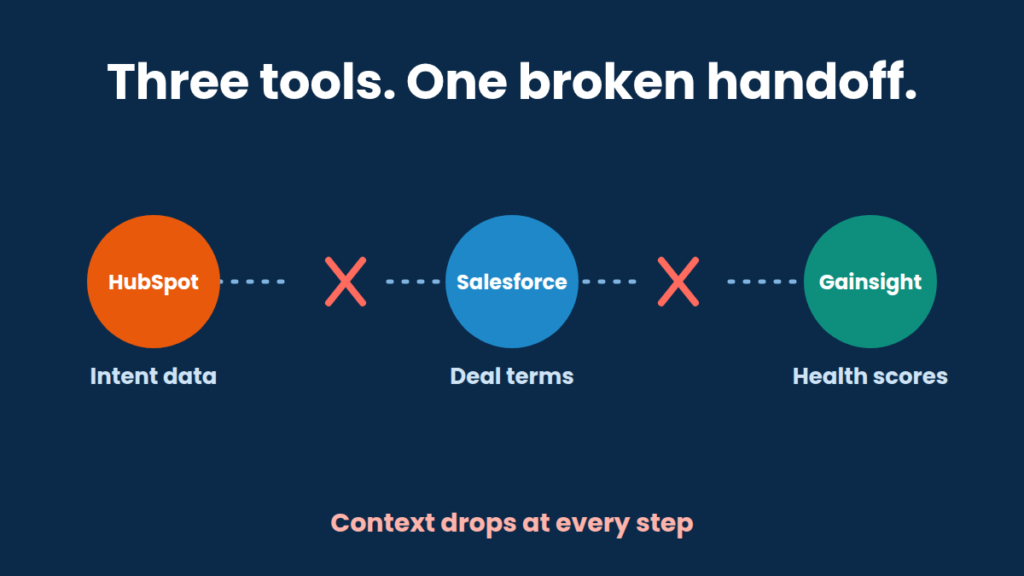
However, when HubSpot, Salesforce, and Gainsight operate as isolated islands, several critical failure points emerge:
The Context Drop at Handoff: When an account closes in Salesforce, the transition to Gainsight is often reduced to a static company profile and a contract value. The nuanced context captured during marketing nurture (via HubSpot), such as specific pain points, feature interests, and stakeholder dynamics, gets left behind. The onboarding team starts from scratch, forcing the customer to repeat themselves.
Disconnected Health Indicators: Many organizations attempt to measure customer health using isolated metrics. If product usage data lives in Gainsight, billing details live in Salesforce, and support tickets sit in an external ticketing system, a CSM looking at a single dashboard only sees part of the picture. A client might have stable login metrics while experiencing severe frustration with billing errors or contract scope misalignments.
The Reporting Time Sink: Executive leadership demands unified reporting on net revenue retention (NRR), gross retention, and pipeline contribution. Without a unified data architecture, operational teams spend days at the end of every month exporting CSVs, running VLOOKUPs, and reconciling discrepancies between Salesforce closed-won revenue and Gainsight actualized ARR.
Architecting a Unified Data Fabric
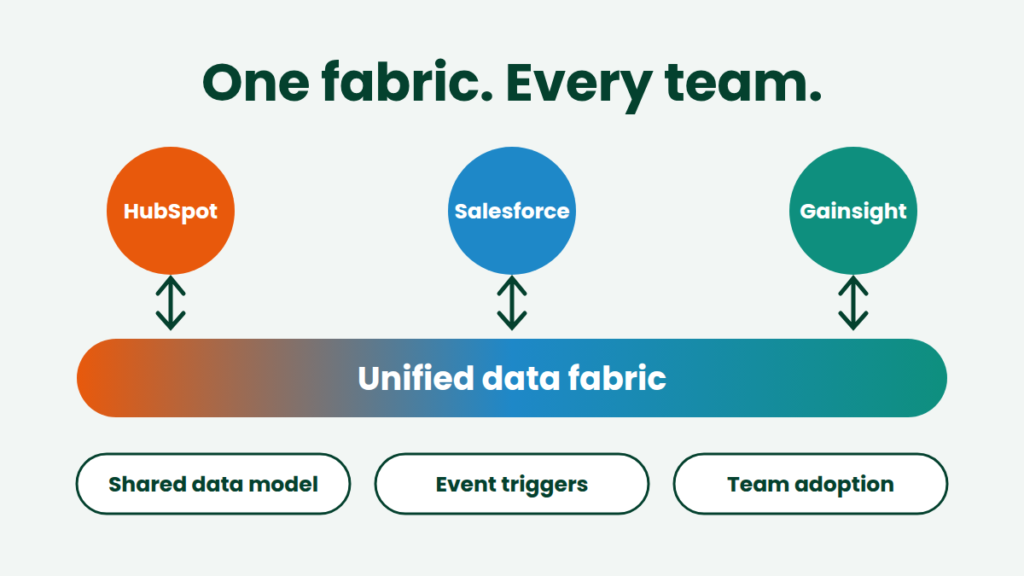
Solving these systemic challenges requires a fundamental shift in how revenue operations (RevOps) are structured. Instead of treating platforms as standalone software applications, organizations must design an integrated data fabric where data flows bi-directionally with high fidelity and zero latency.
Unified Data Modeling and Custom Object Alignment
A robust architecture begins with clean object mapping. Account, Contact, and Opportunity structures in Salesforce must map seamlessly to corresponding Company, Person, and Relationship objects in Gainsight, while maintaining deep historical traceability back to HubSpot marketing campaigns. Standardizing naming conventions, lifecycle stages, and custom fields across systems ensures that every team speaks the same operational language.
Event-Driven Triggers and Automation Playbooks
Static dashboards are reactive; event-driven workflows are proactive. By orchestrating automated triggers across platforms, organizations can initiate immediate operational responses. For instance, when a marketing-qualified account from HubSpot reaches a specific product adoption milestone in Gainsight, automated workflows can notify account executives of cross-sell opportunities while simultaneously alerting CSMs to potential engagement gaps.
Change Management as a Technical Prerequisite
The most sophisticated architecture will fail if internal teams do not adopt it. Technical implementation must always go hand-in-hand with rigorous change management. Defining clear ownership for data hygiene, establishing cross-functional operating rhythms between sales and customer success, and training teams on unified workflows are essential steps for long-term success.
Case Study 1: Transforming Churn Prediction and Visibility for a Growth-Stage SaaS Provider
A high-growth enterprise SaaS organization managing over $40M in ARR used Salesforce for sales pipeline management and Gainsight for customer success tracking, but the two platforms were connected through brittle, legacy point-to-point integrations. Customer health scores relied on lagging indicators, primarily license utilization measured at quarterly intervals, so leading signals such as sudden drops in secondary feature adoption combined with unresolved support inquiries were missed entirely. CSMs spent upwards of 12 hours per week manually reconciling data across spreadsheets, which led to reactive firefighting and preventable customer churn.
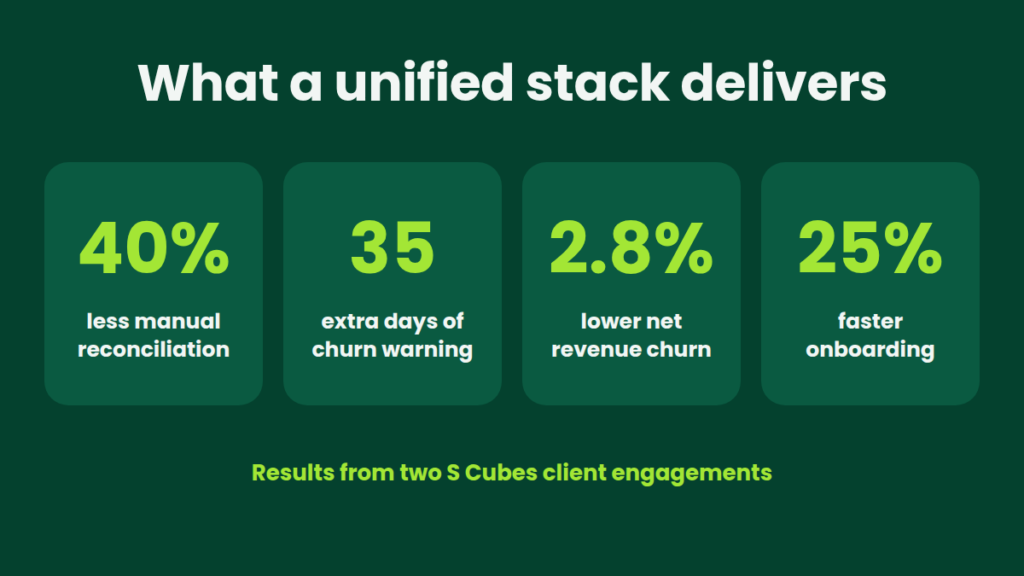
S Cubes IT Consulting partnered with their revenue operations leadership to redesign the entire customer success architecture. We restructured custom objects across Salesforce and Gainsight into a unified data schema that linked commercial contract terms directly to multi-channel product telemetry, re-engineered the Gainsight health scorecards with composite leading indicators that weighted support ticket velocity, stakeholder engagement frequency, and product usage drops, and built automated playbooks that alerted account teams the moment an account shifted from green to amber, complete with contextual briefing notes and task assignments. The impact was a 40% reduction in manual data entry and reconciliation time for CSMs, a warning window extended by 35 days so teams could intervene before renewal discussions stalled, and a verified 2.8% decrease in net revenue churn within two quarters of deployment. In the words of Aarav Mehta, VP of Customer Operations & Success, “S Cubes IT consulting brought an exceptional blend of technical depth and strategic empathy. They didn’t just configure our tools; they aligned our entire team around a unified view of the customer.”
.
Case Study 2: Bridging HubSpot and Gainsight for Seamless Client Onboarding
A rapidly expanding B2B digital services and software enterprise was scaling its client base across North America when its growth exposed a critical disconnect: inbound marketing and sales pipeline data lived entirely in HubSpot, while client onboarding and long-term retention were managed in Gainsight. Because marketing intent data and initial sales notes never made it into Gainsight, the onboarding team consistently lost context. Clients frequently had to restate their primary objectives, and onboarding timelines regularly ran past target SLAs due to missing requirement documentation.
Brought in to audit and overhaul the operational tech stack, S Cubes engineered a bi-directional pipeline so that marketing form submissions, initial stakeholder notes, and contracted service tiers captured in HubSpot automatically populated client onboarding cards in Gainsight upon deal closure. We also designed intuitive custom objects and milestone trackers that gave onboarding specialists instant visibility into what was promised during the sales cycle, and ran tailored enablement sessions for marketing, sales, and customer success teams to ensure full adoption of the new handoff process. The result was 100% visibility across the customer lifecycle, from the first HubSpot marketing touchpoint to ongoing Gainsight retention management, a 25% shorter onboarding duration that accelerated time-to-value for new accounts, and the end of cross-departmental friction, with handoff meeting preparation dropping from hours to minutes.
.
Building for Sustainable Scale
Technology should amplify human potential and empower teams to build authentic, lasting customer relationships. When your revenue tech stack operates as a unified omnichannel fabric rather than a collection of isolated silos, your teams spend less time fighting with data and more time driving customer value.
Implementing and optimising enterprise platforms like Salesforce, HubSpot, and Gainsight requires a strategic partner who understands both the technical architecture and the human change management required to make it stick.
Ready to transform your tech stack into a scalable engine for revenue growth? Connect with the team at S Cubes IT Consulting to explore how we can architect your custom CRM and Customer Success roadmap.