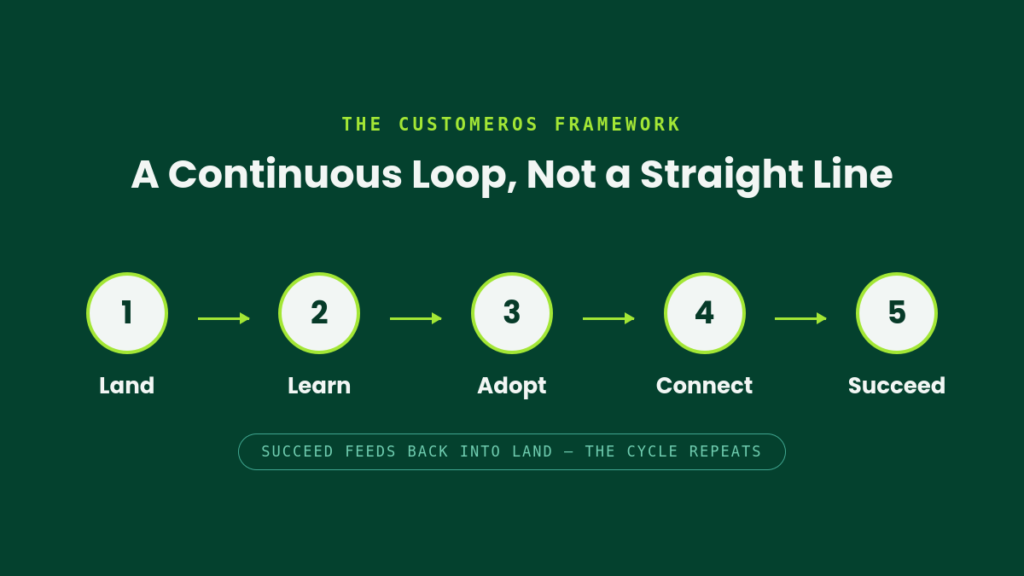
For the last decade, B2B SaaS companies have built their go-to-market motions around a rigid, linear pipeline: Land, Adopt, Expand, Renew. In a traditional sales funnel, customers move step by step from awareness to purchase, with the focus placed primarily on completing the transaction. It is a highly vendor-centric model that fundamentally misunderstands how modern software is consumed. The reality is that the modern customer journey is non-linear, happens across multiple channels, and is highly personalized. Customers do not experience your product in a straight line; their engagement is continuous, fragmented, and influenced by shifting internal business priorities.
When your revenue architecture is built entirely around internal sales stages, your technology stack inevitably becomes just as fragmented. Sales data lives isolated in Salesforce, marketing nurtures leads in HubSpot, and customer success managers fight daily fires in Gainsight. The result is disjointed handoffs, siloed account data, and customers who feel like they are starting from scratch every time they speak to a new department. To drive sustainable Gross Revenue Retention (GRR), enterprise teams must shift away from the linear funnel and embrace a customer-centric model: The CustomerOS Framework.
This modern operational framework focuses on continuous loops Land, Learn, Adopt, Connect, and Succeed and requires a technology stack that is intentionally rewired to support it. A true customer success journey map lays out the entire path a client follows from their first sign-up to their continued engagement with your product or service. Here is a deep dive into how B2B leaders are breaking down data silos, leveraging AI, and turning fragmented systems into a unified, predictable retention engine.
The Problem: The Linear Tech Stack Trap and “Dark Data”
When systems are implemented in isolation, they inevitably create “dark data” crucial customer signals that exist in the digital ether but are never surfaced to the people who need them. Consider a standard enterprise account scenario:
- A key user attends an advanced technical webinar to solve a specific workflow problem (tracked entirely in HubSpot).
- That same user submits three complex, frustrated support tickets over the next week (tracked entirely in Salesforce Service Cloud).
- Meanwhile, their overall account health score remains a pristine “Green” because their daily login rate has not dropped (tracked entirely in Gainsight).
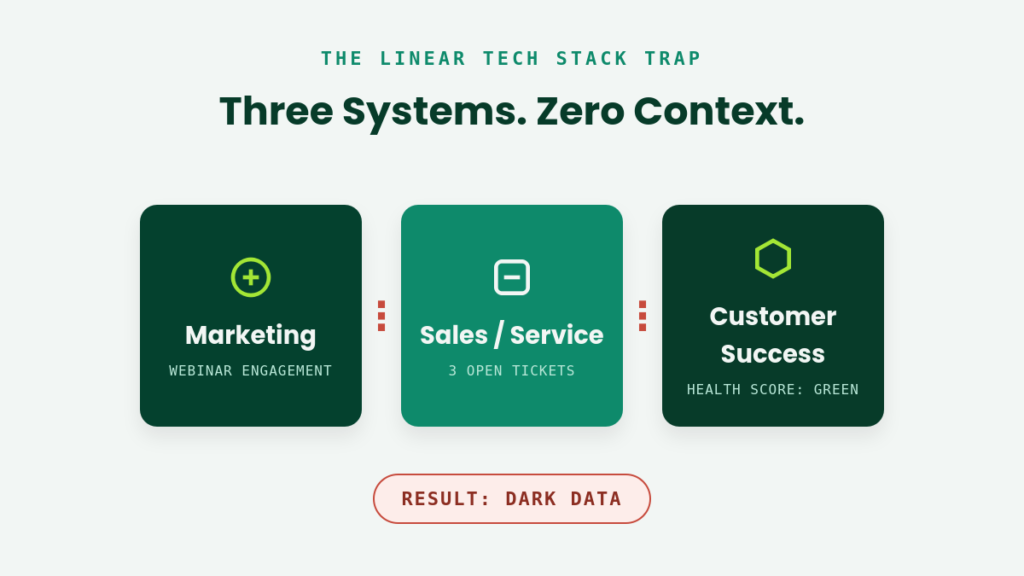
In a traditional linear model, the Customer Success Manager (CSM) is completely blind to the friction the customer is experiencing until the renewal conversation approaches. By then, it is often too late to salvage the relationship. These fragmented touchpoints mean customers expect a seamless experience across digital and physical channels but instead face generic messaging and uncoordinated outreach. The CustomerOS framework solves this by normalizing data across all platforms, ensuring that every touchpoint, whether it is a marketing engagement, a product click, or a support ticket, is fed into a single, actionable orchestration layer.
Architecting the CustomerOS: Moving Beyond Basic Integrations
To build a CustomerOS, companies must move beyond basic, one-way API calls and establish robust, bi-directional synchronization. The goal is to orchestrate go-to-market activities between sales, marketing and customer success by creating unparalleled visibility between teams with transparent access to customer health, sentiment and survey responses.
This architectural shift typically involves three core pillars:
- Unified CRM Telemetry: Connecting HubSpot CRM and Gainsight eliminates data gaps by utilizing robust integrations across more than a dozen object types. This ensures that marketing engagement metrics directly influence health scoring.
- Centralized Customer Insights: Gainsight’s bi-directional integration with Salesforce centralizes existing customer data to surface important insights and actions for your customers, preventing CSMs from having to context-switch between platforms.
- Agentic AI and Model Context Protocol (MCP): The most advanced CustomerOS architectures now integrate autonomous AI agents capable of reasoning over this unified data. Instead of a CSM manually pulling a report to check if an account is healthy, an AI agent continuously monitors the normalized data warehouse and triggers Gainsight playbooks the moment churn signals are detected.
Case Study 1: Eliminating Handoff Friction for a Global HealthTech Platform
The Challenge: A rapidly scaling telehealth platform was experiencing an unacceptably high rate of early-stage churn. Their Sales team was successfully closing complex enterprise deals in Salesforce, but the handover to the CS team in Gainsight was entirely manual and poorly documented. Vital context regarding the client’s specific clinical goals was being lost in translation. As a result, customers were growing frustrated during the critical onboarding phase, forcing them to repeat their success criteria to multiple account managers.
The S Cubes Solution: We stepped in to architect a unified CustomerOS. We rebuilt the underlying data model between Salesforce and Gainsight, automating the transition from the initial purchase phase into the crucial learning and onboarding phase.
- Automated Context Sync: We configured custom objects in Salesforce that captured deep technical and clinical requirements during the sales cycle. We then mapped these fields directly to Gainsight Success Plans, ensuring a bi-directional data flow.
- Journey Orchestration: We deployed Gainsight Journey Orchestrator to trigger customized, digital-touch onboarding sequences the exact moment an opportunity was marked “Closed Won” in Salesforce, ensuring immediate momentum and eliminating manual delays.
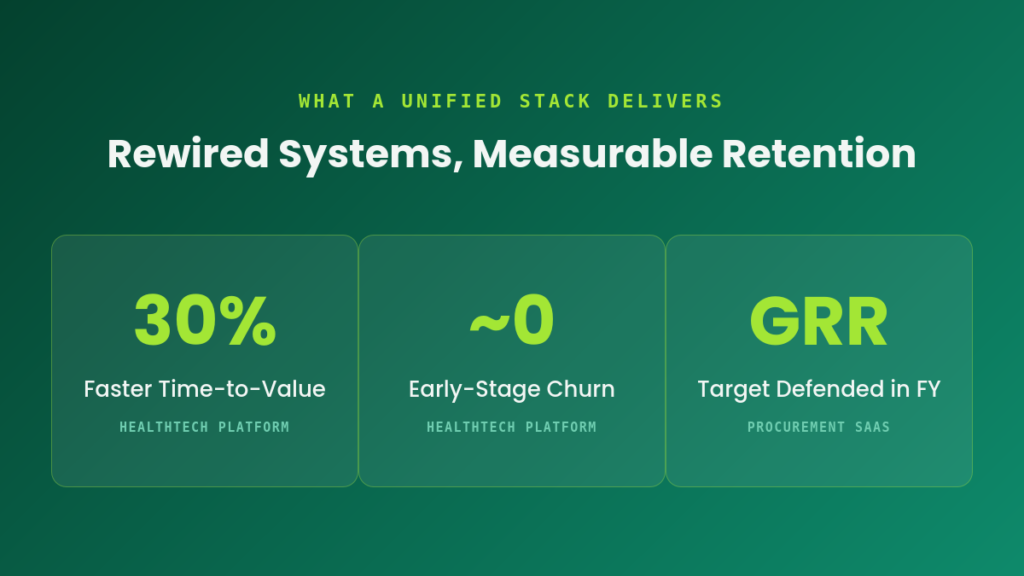
The Outcome: By rewiring the integration to support the customer’s learning curve rather than the vendor’s internal processes, the client reduced Time-to-Value (TTV) by 30%. Customers no longer had to repeat their goals to the CSM, and early-stage churn dropped to near zero within two quarters.
Case Study 2: Turning Telemetry into Proactive Retention for an Enterprise Procurement SaaS
The Challenge: A leading procurement software company boasted a highly technical, feature-rich product, but their CSMs were operating in a strictly reactive capacity. Their HubSpot marketing data, Salesforce pipeline data, and Gainsight health scores were completely disconnected. Because they lacked visibility into true product adoption, CSMs were functioning as glorified support agents, responding to tickets rather than acting as strategic advisors guiding the client’s growth.
The S Cubes Solution: The client needed to shift their focus from basic adoption to the “Connect and Succeed” phases of the modern journey. We integrated their fragmented stack to create a real-time, event-driven architecture.
- Unified Telemetry: We normalized their raw product usage data and pushed it into Gainsight alongside HubSpot engagement metrics, such as webinar attendance and email click-through rates. This eliminated data gaps between their HubSpot CRM and the Gainsight platform.
- Advanced Health Scoring: We moved the organization away from static, single-metric health scores based purely on logins. Instead, we built a multi-dimensional scorecard in Gainsight that automatically flagged risk if a customer stopped utilizing key “sticky” features even if their overall login rate remained high.
- Proactive Playbooks: We engineered automated Call to Action (CTA) triggers. If product adoption stalled in a specific module, the system automatically routed a task to the CSM with a prescriptive playbook to guide the customer back to success.
The Outcome: The RevOps and CS Ops teams finally shared a single source of truth. The unified architecture eliminated blind spots, empowered CSMs to intervene proactively before renewals were threatened, and successfully defended their Gross Revenue Retention (GRR) targets for the fiscal year.
Rewire Your Stack for Revenue
A modern customer success strategy cannot run on legacy, fragmented architecture. If your team is spending more time managing software, manually updating spreadsheets, and searching for context than they are driving actual client outcomes, your tech stack is actively working against you.
At S Cubes IT Consulting, we build and run the operational backbone that scales with your growth. We specialize in connecting Gainsight, Salesforce, HubSpot, and advanced Agentic AI into one seamless, predictable revenue engine.
Stop tracking basic activity and start delivering verifiable outcomes. Transform your customer success team into a revenue growth engine today.