As software companies scale past the $20M ARR mark, a subtle, highly destructive organizational friction begins to take root. It rarely starts with a loud argument or a boardroom showdown. Instead, it starts quietly: a CSM creates a custom field in Gainsight without telling anyone; a RevOps analyst updates a Salesforce object layout, inadvertently breaking a critical sync mapping; and executive dashboards begin to display three different versions of customer health.
Welcome to the RevOps vs. CS Ops turf war.
As Customer Success (CS) transitions from a touch-and-feel retention function into a rigorous, data-driven revenue engine, the technology stack supporting it has grown exponentially complex. Gone are the days when a simple spreadsheet and a shared inbox sufficed. Today’s enterprise CS stack is an intricate, multi-layered architecture involving core CRMs (Salesforce or HubSpot), dedicated customer success platforms (like Gainsight or Totango), product telemetry engines, billing systems, and AI orchestration layers.
Yet, when it comes to who actually owns, maintains, and governs this ecosystem, organizational ambiguity reigns. RevOps claims ownership because the stack touches revenue, data pipelines, and cross-functional reporting. CS Ops lays claim because the platform dictates CSM workflows, customer journey orchestration, and day-to-day retention execution.
When nobody owns the boundary lines, data rots, implementation drift sets in, and Net Revenue Retention (NRR) suffers. Resolving this turf war requires moving away from territorial silos and establishing a strict, architectural division of labor.
- The Anatomy of the Turf War: Two Divergent Philosophies
To understand why this conflict is so pervasive, we have to look at the fundamentally different incentives, skill sets, and operational mandates of the two functions.
The RevOps Mindset: System-Wide Integrity and Top-Down Visibility
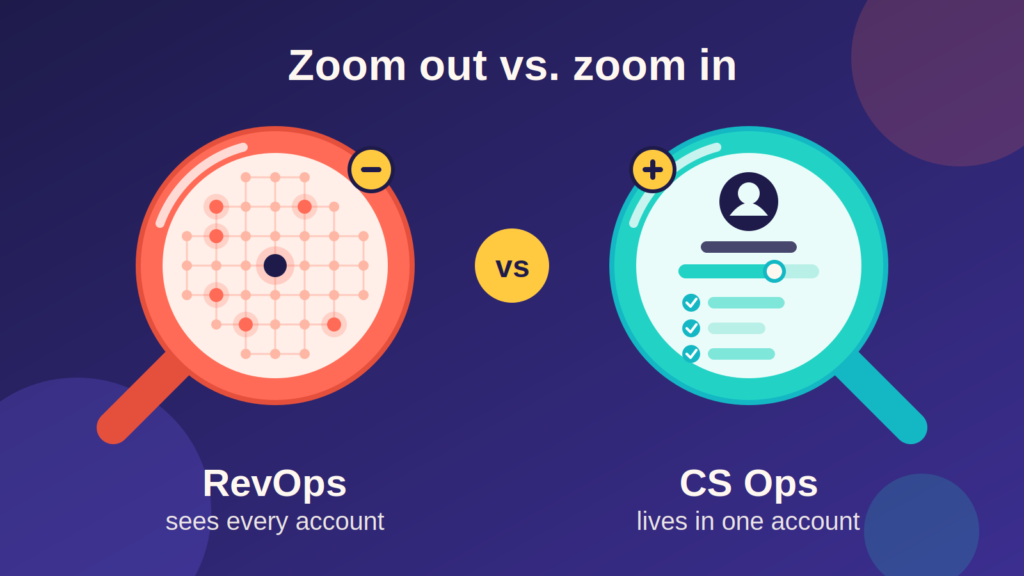
Revenue Operations is inherently macro-focused. RevOps leaders view the entire quote-to-cash lifecycle as a continuous data pipeline. Their primary objectives are pipeline velocity, data hygiene, attribution accuracy, and predictable forecasting.
From a RevOps perspective, the CS tech stack is simply a node albeit a critical one within the broader enterprise data architecture. They worry about API rate limits, duplicate account creation, global data governance rules, and ensuring that executive leadership has clean, uncorrupted inputs for board decks. When a CS team requests a new tool or a custom object, RevOps looks at it through a risk lens: Will this break our data model? Will this create downstream reporting anomalies in Salesforce?
The CS Ops Mindset: Workflow Efficiency and Adoption
Customer Success Operations, on the other hand, is micro- and workflow-focused. CS Ops leaders measure their success by how efficiently a CSM can manage their portfolio, how quickly early-churn indicators trigger proactive playbooks, and how seamlessly customer insights translate into action.
From a CS Ops perspective, the platform (whether Gainsight, Catalyst, or HubSpot Service Hub) is a day-to-day operational workspace, not just a database. They care deeply about UI/UX friction, cockpit task load, Journey Orchestrator logic, and making sure CSMs aren’t drowning in notification fatigue. When RevOps blocks a workflow modification due to “data governance rules,” CS Ops views it as administrative red tape that directly harms customer-facing execution.
When these two mindsets collide without a governance framework, the tech stack becomes a battleground of competing priorities.
- The Technical and Data Cost of Ambiguity
When ownership of the CS tech stack is left ambiguous, the organization pays a steep price in both technical debt and operational efficiency.
Data Fragmentation and the “Two-Truths” Problem
The most common symptom of the turf war is data fragmentation. Product telemetry data lives in a data warehouse (like Snowflake or BigQuery), customer commercial data lives in Salesforce, and health scores live in Gainsight.
Without unified ownership, these systems begin to drift. RevOps might alter account segmentation rules in the CRM without updating the mapping logic in the CS platform. Suddenly, enterprise accounts are misclassified as SMBs within the CS platform, triggering incorrect automated playbooks and misleading health scores. CSMs open their dashboards, notice the data doesn’t match reality, lose trust in the tool, and revert to tracking accounts in private spreadsheets.
The Root Cause of “Month 3 Gainsight Failures”
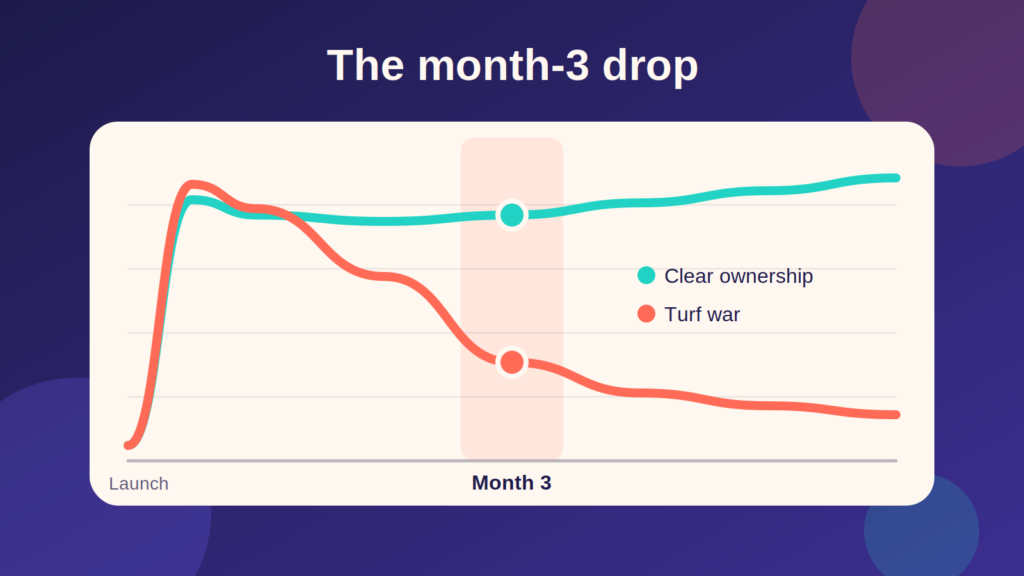
Many enterprise CS implementations launch with immense fanfare, only to experience catastrophic adoption drops by month three. While poor change management is often blamed, the underlying culprit is usually structural ownership failure.
When RevOps configures the initial setup without deep CS operational input, the workflows feel robotic and disconnected from real-world account dynamics. Conversely, when CS Ops builds complex, hardcoded rules without robust data engineering backing them up, the backend database collapses under the weight of messy logic. The system becomes rigid, fragile, and ultimately unmaintainable.
- Defining the R&R Boundary: Who Owns What?
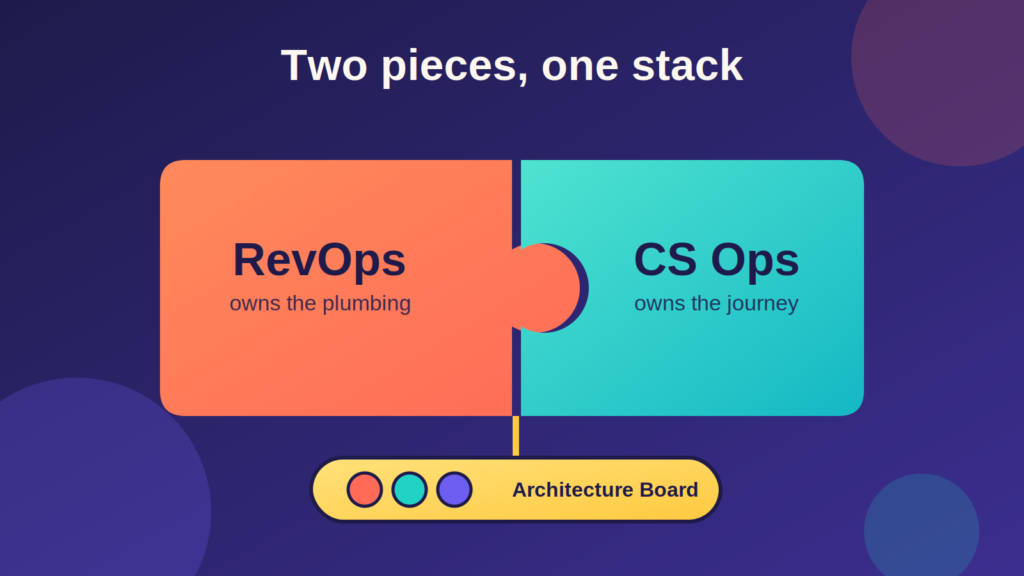
Solving the turf war does not mean choosing a side. It means drawing clear, non-negotiable boundaries between Data Architecture and Lifecycle Orchestration.
To build a scalable, high-performing revenue engine, organizations must divide responsibilities across clear functional lines:
What RevOps Must Own: The Data Foundation & Infrastructure
RevOps should retain undisputed ownership over the structural integrity and data plumbing of the stack. Their remit includes:
- Core Data Schemas and Objects: Defining standard account, contact, and contract objects across Salesforce/HubSpot and downstream systems.
- API Integrations and Data Pipelines: Managing bi-directional syncs, middleware (like Census, Hightouch, or Workato), and data warehouse connections.
- Global Security and Governance: Ensuring compliance, managing user permissions, license provisioning, and maintaining data hygiene standards.
- Global Reporting Infrastructure: Owning board-level metrics, macro-level NRR, GRR, and aggregate revenue attribution reporting.
What CS Ops Must Own: Business Logic & Journey Orchestration
CS Ops should maintain absolute ownership over how customer data is operationalized into human workflows. Their remit includes:
- Customer Journey Mapping & Lifecycle Stages: Defining what constitutes onboarding, adoption, renewal, and advocacy stages.
- Health Score Business Logic: Determining what signals matter for customer health (combining product usage, support sentiment, and commercial engagement) while partnering with RevOps to ensure the data is mathematically sound.
- Journey Orchestrator and Playbooks: Designing automated alerts, risk triggers, and success plans that drive CSM action.
- Cockpit Layouts and CSM Enablement: Optimizing the daily workspace to minimize administrative drag and maximize account visibility for the front-line team.
Case Study 1: How CloudScale Analytics Reclaimed Workflow Velocity
Executive Summary
CloudScale Analytics faced a critical operational bottleneck when a turf war between RevOps and CS Ops locked down their tech stack. Strict Salesforce data controls meant simple Gainsight workflow updates took up to 90 days, causing frontline CSM disengagement and missed retention signals.
The Solution
S Cubes implemented a decoupled architecture using Census for reverse-ETL. This allowed RevOps to maintain ironclad control over core data plumbing in Snowflake while carving out a secure, sandboxed workspace for CS Ops to manage Journey Orchestrator playbooks independently.
The Impact
-
+32% surge in quarterly playbook execution by frontline CSMs.
-
Zero API breakages or data pipeline failures over a six-month observation window.
-
Workflow deployment time dropped from 90 days to under 48 hours.
- Establishing the “Rev-CS Architecture Board”
Dividing responsibilities on paper is easy; maintaining them during rapid scale requires structural governance. High-performing organizations establish a lightweight, cross-functional Rev-CS Architecture Board that meets bi-weekly or monthly.
This board consists of the RevOps lead, the CS Ops lead, and a representative from IT or Data Engineering. Their charter is simple:
- Change Management Protocol: Any proposed change to an object schema, health score algorithm, or major integration must be reviewed by the board to assess both data integrity and workflow impact.
- Backlog Prioritization: Balancing engineering requests (e.g., cleaning up technical debt in the data pipeline) with operational requests (e.g., launching a new expansion playbook for Q3).
- Audit and Maintenance: Conducting quarterly reviews of custom fields, unused rules, and orphaned integrations to keep the tech stack lean and performant.
Case Study 2: How Omnimetrics Eliminated Dashboard Rot.
Ahead of a Series C raise, OmniMetrics suffered from “dashboard rot”—competing health scores and conflicting NRR metrics created by years of siloed configuration between RevOps and CS Ops. Leadership spent more time arguing over data accuracy than reviewing retention trends.
The Solution
S Cubes established a cross-functional Rev-CS Architecture Board, purged over 140 orphaned custom fields across HubSpot and Gainsight, and engineered a unified composite health score blending commercial stability with product telemetry.
The Impact
-
100% executive alignment across all board-level NRR and health reporting.
-
4.2x increase in frontline CSM platform trust and dashboard utilization.
-
Seamless Series C due diligence with fully audited and verified customer metrics.
Executive Summary
Ahead of a Series C raise, OmniMetrics suffered from “dashboard rot”—competing health scores and conflicting NRR metrics created by years of siloed configuration between RevOps and CS Ops. Leadership spent more time arguing over data accuracy than reviewing retention trends.
The Solution
S Cubes established a cross-functional Rev-CS Architecture Board, purged over 140 orphaned custom fields across HubSpot and Gainsight, and engineered a unified composite health score blending commercial stability with product telemetry.
The Impact
-
100% executive alignment across all board-level NRR and health reporting.
-
4.2x increase in frontline CSM platform trust and dashboard utilization.
-
Seamless Series C due diligence with fully audited and verified customer metrics.
.
Conclusion: Turning a Turf War into a Growth Engine
The debate over whether RevOps or CS Ops “owns” the Customer Success tech stack is fundamentally the wrong question. Asking who owns the stack implies it is a piece of property to be defended.
In reality, the CS tech stack is the bridge between commercial intent and customer value realization. When RevOps and CS Ops view each other as adversaries competing for control, the bridge collapses under the weight of fragmented data and broken workflows.
By drawing clear architectural boundaries letting RevOps master the data plumbing while empowering CS Ops to orchestrate the human journey organizations can eliminate friction. When the infrastructure and the execution layer finally speak the same language, the tech stack stops being a costly turf war and becomes what it was always meant to be: a unified engine for predictable, scalable net retention.