
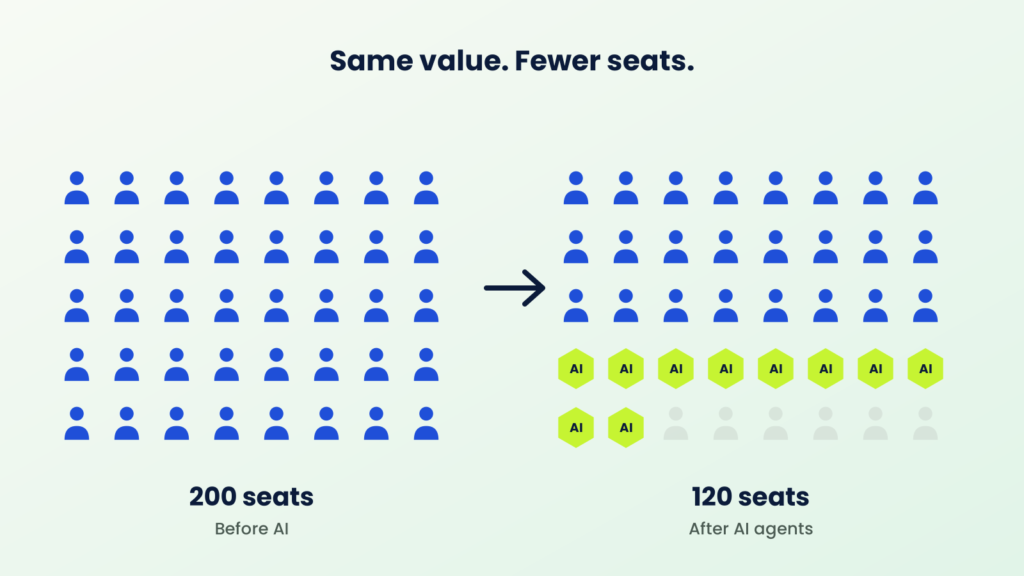
The renewal call starts the way it always does. Then your champion says it: “We’re rolling out AI agents across support, so we’ll only need 120 seats instead of 200.” Nothing is wrong with your product. Adoption is healthy and the team likes it. The customer simply needs fewer humans logging in.
Welcome to per-seat compression. For B2B SaaS companies built on seat-based pricing, it may be the most important revenue risk of the next few years, and most customer success teams are not set up to see it coming.
The Quiet Squeeze
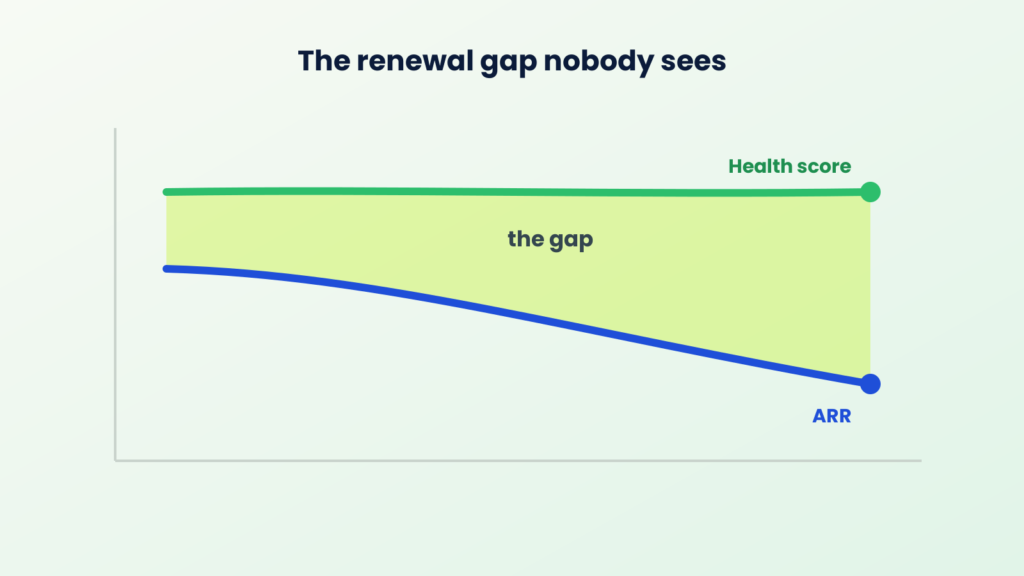
Per-seat compression doesn’t look like churn. Logos stay, health scores stay green, and NPS holds steady. But as customers automate tasks that once needed a person, the number of licensed users shrinks, and contract value shrinks with it.
This is dangerous because traditional CS metrics miss it. A health score built on logins, feature usage and sentiment can read “healthy” while the account loses a third of its ARR at renewal. Gross retention can slip even when logo retention looks fine.
The pressure comes from both sides. Your customers’ finance teams now ask, “If AI does this work, why are we paying for so many licenses?” And your customers’ own AI tools increasingly act inside your product through APIs and agents, doing work no seat ever measured.
Why Defending Seats Is the Wrong Fight
The instinct is to resist: discount to hold the count, push multi-year lock-ins, or argue that every seat is still needed. These tactics buy a quarter or two, but they put you in an adversarial position with a customer who is genuinely becoming more efficient.
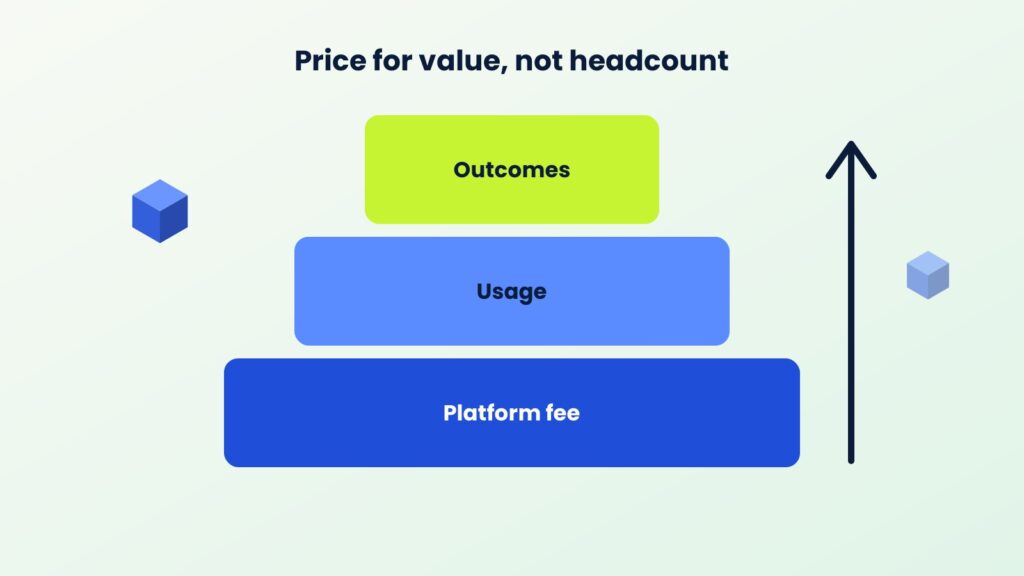
The better question is: what value does the customer get from us, and how do we price and prove that instead of headcount? Seats were only ever a proxy for value. When the proxy breaks, the value is still there, and your job is to make it visible.
Four Moves to Protect Revenue
- Detect compression early. Add leading indicators to your customer health model: seat utilization trends, the ratio of agent-driven to human-driven activity, announced AI initiatives, and headcount changes at the customer. In Gainsight, these signals can feed Scorecards and Cockpit rules so CSMs are alerted 180 days out, not 30.
- Measure outcomes, not logins. Track what the customer actually achieves with your product: tickets resolved, deals closed, hours saved, revenue influenced. Bring those numbers into every executive business review so the conversation is about results, not licenses.
- Evolve the commercial model. Move toward a hybrid structure: a platform fee that anchors baseline revenue, plus usage- or outcome-based components that scale as the customer gets more value from automation. Customers who automate more should pay more for outcomes, not less for seats.
4. Expand into the new surface area. When seats fall in one team, value often opens up elsewhere: new departments, AI-agent access, premium analytics, or services. A well-run expansion motion, tied to CRM and CS data in one place, turns compression in one area into growth in another.
Case Study 1: Re-Basing a Support Platform’s Renewals
The situation. A mid-market SaaS vendor sold a support-workflow product at roughly 200 seats per enterprise customer. As customers deployed AI agents to handle tier-one tickets, renewal conversations kept starting with requests to cut seats by 30 to 40 percent. Health scores still showed green.
What S Cubes did. We rebuilt the Gainsight health model around compression signals, including seat-utilization trend, share of automated activity and customer AI announcements, and wired those into Cockpit playbooks that trigger an executive conversation 180 days before renewal. We then helped the team design a hybrid offer: a smaller seat base plus a usage-based tier for automated resolutions.
The result. Renewals shifted from defending headcount to discussing outcomes. Net revenue retention on the affected cohort held above 100 percent, because lost seats were offset by usage revenue and an expanded footprint. The CS team gained a repeatable renewal playbook instead of ad hoc firefighting.
Case Study 2: Unifying CRM and CS Data to Find the Expansion
The situation. A B2B SaaS company running Salesforce and Gainsight had fragmented data. Sales saw contract values, CS saw usage, and nobody could see which accounts were compressing and which were quietly growing in new teams. Expansion opportunities sat undiscovered.
What S Cubes did. We aligned the Salesforce and Gainsight data models so account, usage and opportunity data flowed in both directions. We then built a single view of seat trends, agent-driven usage and cross-department adoption, and set up automated alerts to route expansion signals to the account owner.
The result. The team could finally tell “shrinking because of AI” from “shrinking because of risk.” For accounts that were compressing, CSMs opened conversations about adjacent teams and premium capabilities, recovering a meaningful share of at-risk ARR through expansion rather than discounting.
.
Where to Start This Quarter
You don’t need to redesign your pricing overnight. Begin with three steps:
- Audit your top 50 accounts for seat-compression exposure and AI initiatives.
- Add at least two leading indicators to your health model.
- Draft an outcome-based narrative for your next ten renewals.
The Bottom Line
AI isn’t only a threat to seat-based revenue; it’s a forcing function to prove value more clearly than ever. The vendors who thrive will be the ones who see compression coming, quantify outcomes, and price for the value they deliver.
If you want to pressure-test your renewal risk, S Cubes helps B2B SaaS teams design Gainsight and Salesforce architectures that surface these signals early. Reach out at scubes.net.