
Every Gainsight rollout gets a celebration email. Data migrated. Scorecards are live. Playbooks are built. Leadership gets a demo, everyone nods, and the project is marked “complete” in the PM tool.
Month 1 always looks like a success.
Month 3 is where the truth shows up.
That’s when CSMs quietly stop updating fields the “right” way. When the health score starts drifting from what the team actually believes about an account. When the playbooks that looked airtight in the sandbox start getting skipped because they don’t match how work actually happens. Nobody sends an email about that. It just… goes quiet.
We’ve walked into enough “healthy” Gainsight instances eight months post-launch to know the pattern by heart. The implementation wasn’t the problem. The silence after it was.
Why Month 1 Always Looks Fine
Month 1 is supervised. Consultants are still on the account. Leadership is watching adoption dashboards. CSMs are on their best behavior because someone is checking.
None of that is a real signal of success; it’s a signal that people are being watched. The actual test starts the day the implementation partner stops showing up to every call, and the CSMs are left alone with a system that either fits how they work or doesn’t.
The Three Places the Gap Actually Opens Up
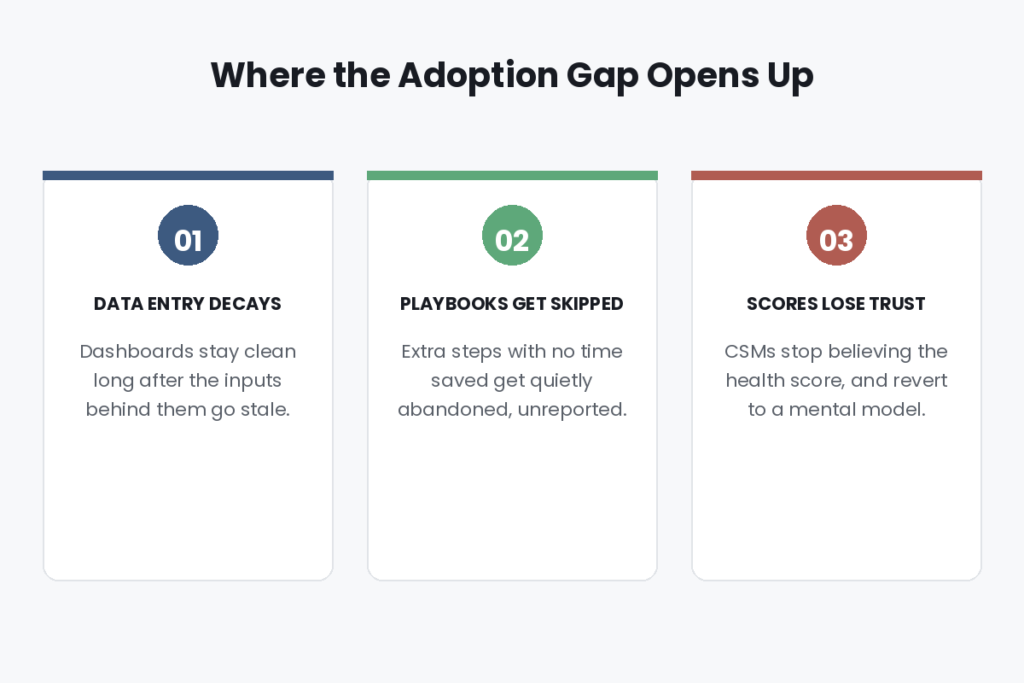
- Data entry decays before dashboards do. Dashboards keep looking clean long after the inputs behind them have gone stale. A CSM who’s slammed will log the outcome but skip the “why,” or reuse last quarter’s notes because the field is mandatory but nobody’s reading it. The system still runs. It’s just running on fiction.
- Playbooks get treated as documentation, not workflow. A playbook designed by CS Ops (who understand the ideal process) rarely survives contact with a CSM managing 40 accounts and three fires. If a playbook adds steps without removing any, it gets skipped quietly and without escalation, because nobody wants to be the one who says, “This doesn’t work.”
- Health scores stop matching gut instinct, and nobody flags it. Once CSMs stop trusting the health score, they stop using it to prioritize. They still update it because it’s a KPI, but they run their real book of business off a mental model in their head. Leadership keeps making calls off a number that’s already been abandoned by the people closest to the account.
None of this shows up as a support ticket. It shows up as a slow, invisible divergence between the system and the reality it’s supposed to represent, and by the time it surfaces (a renewal miss, a churn nobody saw coming), it’s rarely traced back to what actually caused it: adoption that was never designed to survive contact with day-to-day work.
What Actually Prevents It
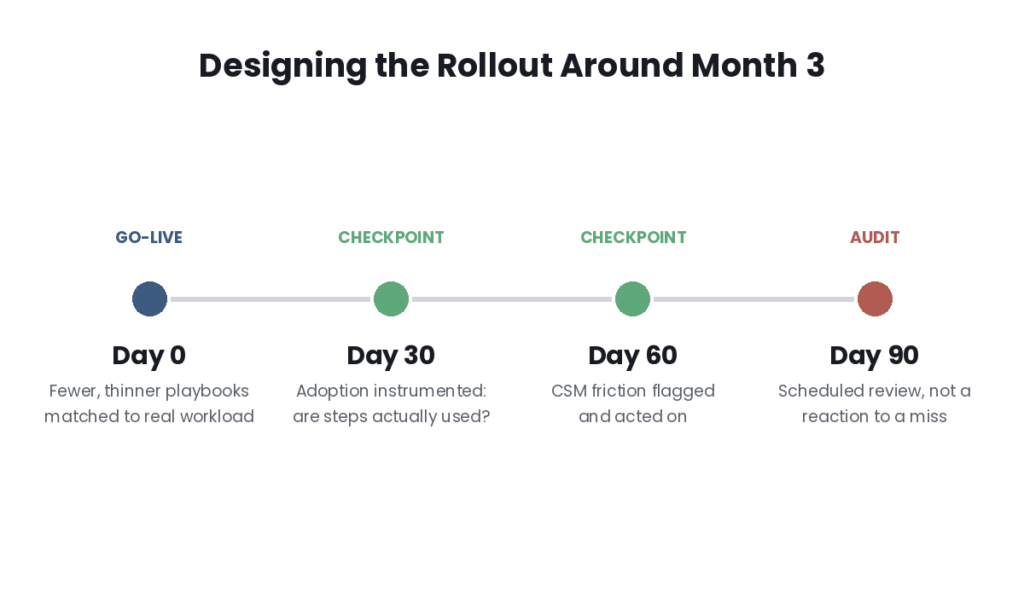
The fix isn’t a better training deck. It’s designing the rollout around week 12, not week 1:
- Build fewer, thinner playbooks that match real workflows, not the ideal-state process CS Ops wishes were true.
- Instrument adoption itself. Track whether CSMs are actually opening and completing playbook steps, not just whether the playbook exists.
- Put a 60- and 90-day checkpoint on the calendar before go-live, not after someone notices a problem. Adoption reviews should be scheduled, not reactive.
- Give CSMs a fast way to flag “this field/step doesn’t make sense” and actually act on that feedback; otherwise, the workaround becomes permanent and invisible.
An implementation that’s designed to be watched will look successful in month 1. An implementation that’s designed to survive being unwatched is the one still working in month 12.
S Cubes in Action: A Mid-Market SaaS Company From “Green Dashboard, Red Reality” to a Score CSMs Actually Trusted
The situation: A ~250-person B2B SaaS company had gone live with Gainsight five months earlier through a different implementation partner. Every account on the health scorecard showed green or yellow. In the same quarter, two accounts representing a meaningful share of ARR churned with almost no warning.
What we found: The health score was built entirely on product usage data pulled at implementation time, with no support sentiment, no renewal-conversation signal, and no CSM qualitative input. CSMs had privately stopped trusting the score months earlier and were tracking risk in a personal spreadsheet instead. The official system and the real system had split apart, and nobody above CSM level knew it.
What we did: We rebuilt the scorecard around a blended model of usage plus support ticket sentiment plus a lightweight, mandatory CSM risk note tied to actual renewal conversations. We cut the playbook from 14 steps to 6, mapped to what CSMs told us they actually had time to do. We also set a recurring 90-day adoption audit as part of the engagement, rather than a one-time handoff.
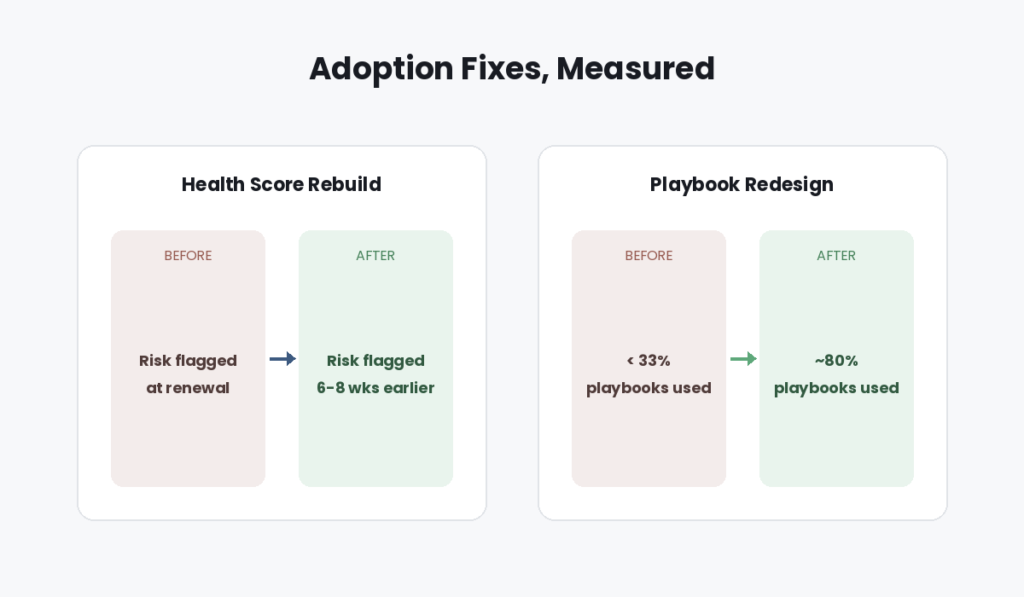
The result: Within two quarters, the scorecard’s risk flags matched CSM instinct closely enough that the team started using it again as their primary tool, not a shadow spreadsheet. At-risk accounts started surfacing 6–8 weeks earlier than before.
S Cubes in Action: A Series C Vertical SaaS Company Rescuing an Implementation That Had “Technically” Succeeded
The situation: A vertical SaaS company had completed a technically correct Gainsight implementation with CTAs, playbooks, and Journey Orchestrator programs all configured to spec. Nine months in, leadership discovered that fewer than a third of configured playbooks had ever actually been triggered by a CSM in production.
What we found: The rollout had been built by people who understood the product deeply but had never sat with a CSM during a live workday. Several “critical” workflows required six clicks across three tabs to log an outcome CSMs used to handle in one line of a shared doc. The tool was correct. It was also slower than the informal process it replaced, so people quietly reverted.
What we did: We ran a week of direct CSM shadowing before touching a single config. We collapsed the highest-friction workflows into one-click actions, retired playbooks nobody was using, and rebuilt the two that mattered most around the CSM’s actual daily rhythm instead of the org chart’s ideal process. We also set up a lightweight adoption dashboard visible to CS leadership, tracking playbook trigger rates weekly rather than assuming configuration equaled usage.
The result: Playbook trigger rates rose from under a third to roughly 80% within one quarter, and CS leadership had, for the first time, an early warning system that reflected what CSMs were actually doing, not just what the system was configured to do.